
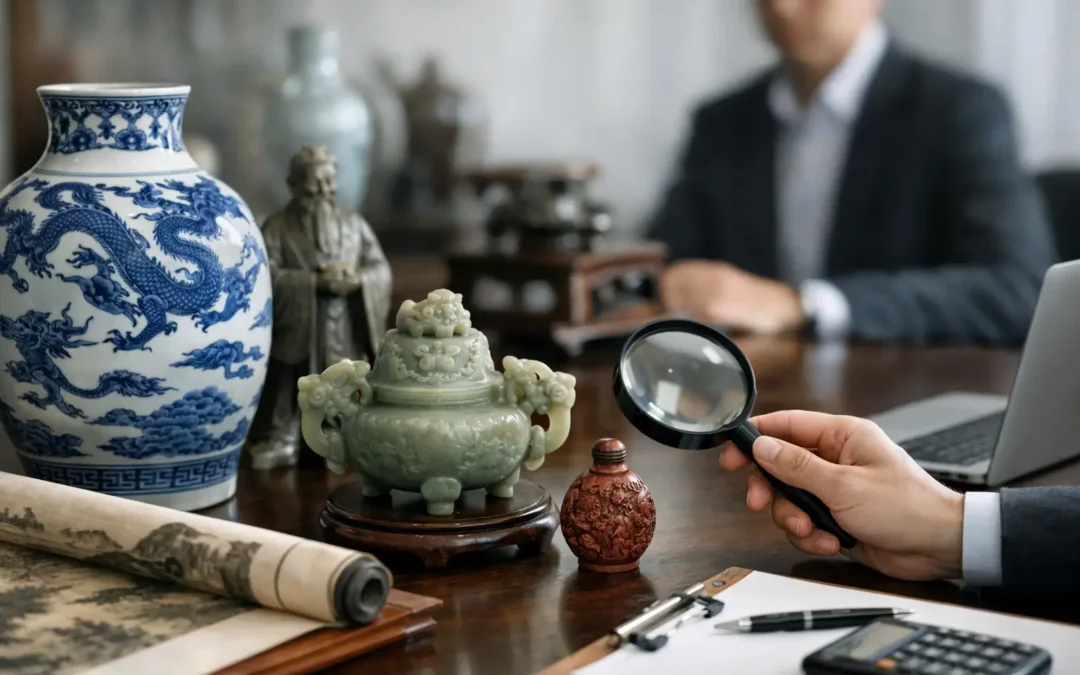
A famille rose vase found in a cabinet, a carved jade pendant kept in a drawer, a blue and white bowl brought back from Hong Kong in the 1970s – these are the kinds of objects that prompt questions about Chinese art valuation UK. The right answer is rarely a quick figure. In practice, value depends on what the object is, when it was made, how confidently it can be attributed, and whether the current market wants precisely that type of piece.
For owners, that distinction matters. A decorative Chinese object may have modest retail appeal yet weak auction demand. Equally, a piece that appears unassuming to a non-specialist can attract strong bidding if it is from the right period, carries convincing provenance, or fits an active collecting category. Valuation is not guesswork. It is the disciplined assessment of object, period, condition and market evidence.
How Chinese art valuation UK is usually approached
A proper valuation begins with identification, not price. Chinese and Asian works cover a wide field – porcelain, jade, hardstone carvings, bronzes, scholar’s objects, furniture, textiles, paintings, snuff bottles and export wares among them. Before any estimate is sensible, the valuer needs to determine the object’s likely date, material, method of manufacture and intended market.
That process often corrects family assumptions. A six-character mark on the base of a vase does not automatically make it imperial or of the period stated. Many later pieces bear apocryphal reign marks. Likewise, age alone is not enough. Nineteenth-century examples can outperform earlier pieces if they are rare, better preserved, or more desirable to current buyers.
The next stage is comparative. Auction houses look at previous results for related objects, but comparison is never mechanical. Two Qianlong-style bowls may look broadly similar in photographs and still differ sharply in value because one is later, one has restoration, or one has a cleaner and more elegant painted design. This is where specialist handling matters.
The factors that most affect value
Period and attribution
The period assigned to a piece is usually the single largest driver of value. Works from recognised dynastic periods, especially where dating is supported by material, palette, footrim, glaze, decoration and form, can sit in an entirely different market from later copies or revival pieces. Yet caution is essential. The market places a premium on confidence, and overstatement can be expensive.
Attribution also operates on a sliding scale. “Kangxi period” carries a different weight from “Kangxi mark and of the period”, and both differ again from “later decorated in the Kangxi style”. Good valuation language is precise because buyers respond to precision.
Provenance and ownership history
Provenance can transform interest. If an object came from a known private collection, a documented country house, or a family that acquired it in China decades ago, that history may support dating and reassure bidders. Old invoices, collection labels, exhibition references and inherited paperwork can all help.
That said, provenance is not a magic ingredient. Weak objects do not become strong simply because they have been in one family for years. Provenance is most powerful when it supports quality and attribution rather than tries to replace them.
Condition
Condition is central to Chinese art valuation UK because restoration is common and not always obvious to owners. Chips to rims, hairlines, overspray, filled losses, polishing to jade, drilled mounts, repainted enamels and replacement covers can all affect price. In some categories, minor wear is tolerated. In others, especially where rarity is not exceptional, condition issues can reduce value materially.
The trade-off is straightforward. A rare porcelain piece with a stable crack may still attract serious bidding; a more ordinary item with the same fault may struggle. The condition question is never simply “damaged or not”. It is how the damage sits against rarity, beauty and demand.
Quality of decoration and craftsmanship
Collectors pay for more than age. They pay for drawing, colour, balance, firing quality, carving skill and aesthetic strength. Within Chinese ceramics, for example, the difference between routine workshop output and a refined, well-potted, crisply painted example can be substantial. The same is true of jade and hardstone carvings, where the quality of the material and the intelligence of the carving are often more important than size.
Rarity and market demand
Rarity only matters if somebody wants the object. Certain categories enjoy sustained international demand, while others move in and out of favour. A good valuer tracks this in real time. Export porcelain, scholar’s works, Republic period decorative pieces, carved brush pots, Chinese furniture and works of art for the export market each have their own buyer base and price behaviour.
This is why estimates sometimes surprise owners. A large piece is not always more valuable than a small one, and elaborate decoration is not always preferred to elegant simplicity. Market appetite can be highly specific.
Why marks are only part of the story
Owners often start with the base mark, and understandably so. Marks feel definitive. In reality, they are evidence, not proof. Chinese ceramics and works of art frequently carry reign marks copied in later periods as a mark of respect, stylistic reference or commercial appeal.
A valuer therefore reads the mark alongside the body, glaze, enamels, wear, footrim and form. If these elements do not align, the mark cannot be taken at face value. This is one of the most common points where online guesswork goes wrong. Photographs of a mark alone rarely support a reliable valuation.
Auction estimate, insurance value and probate value are not the same
One of the most useful clarifications in Chinese art valuation UK is that value changes according to purpose. An auction estimate reflects what a specialist auction house believes an item may achieve in a competitive sale under current market conditions. It is commercial and evidence-led.
An insurance valuation is typically higher because it reflects replacement cost in the retail market. Probate valuation is different again. It is concerned with fair market value at a relevant date for estate purposes. Owners can become confused when figures vary, but the variation is often entirely legitimate. The key is to request the right valuation for the right reason.
When online research helps and when it misleads
There is nothing wrong with preliminary research. Looking at comparable objects can help owners understand category and terminology. Problems begin when asking prices are mistaken for achieved prices, or when a broadly similar object is assumed to be equivalent. Chinese art is full of fine distinctions that materially affect value.
This is particularly true with porcelain and jade. Later examples can imitate earlier styles convincingly to the untrained eye. Photographs flatten surface, weight and workmanship. Even honest sellers may misdescribe pieces. Market data needs interpretation, not just collection.
What to prepare before seeking a valuation
Owners can make the valuation process more efficient by assembling any history they have. Where was the object acquired? Has it been in the family for generations? Is there a receipt, a letter, an old auction ticket or a label underneath? Has any restoration been carried out?
Clear photographs also help as a starting point – overall views, base, close details and any faults. However, stronger pieces often merit in-person inspection. Weight, translucency, carving depth, enamel texture and signs of repair are not always properly judged from images alone.
For sellers in the South East, working with an established auction house such as John Nicholson’s can be particularly useful when Chinese and Asian works sit alongside other estate property. The advantage is not merely a valuation figure but a practical route to sale, estimate setting and exposure to the right bidding audience.
Why specialist sale context matters
A Chinese work of art does not perform in a vacuum. It performs within the context of cataloguing, photography, estimate strategy and the audience reached. An object placed in a specialist sale with accurate cataloguing and sensible estimate guidance may draw far stronger interest than the same piece offered generically.
This is where commercial judgment comes in. Set an estimate too high and bidding can stall before it begins. Set it too low without confidence in the audience and the result may disappoint. The best auction houses balance ambition with realism. They understand not just what an object is, but who is likely to compete for it.
That applies equally to modest pieces. Not every Chinese object is a museum piece, nor does it need to be. Good middle-market material can sell very well when correctly described and sensibly pitched. Honest valuation serves owners better than inflated promises.
Chinese art valuation UK is therefore less about finding a number than establishing an informed position. If the object is right, the market will often do the rest. If it is not, a clear and grounded assessment is still valuable, because it allows owners to make decisions with confidence rather than hope.