
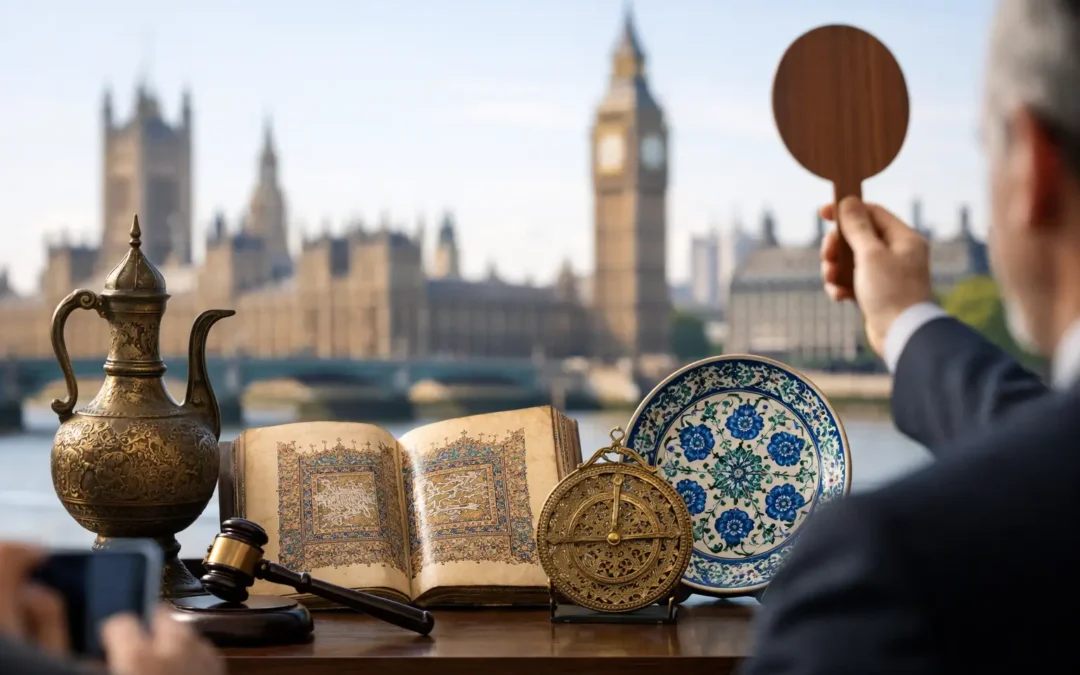
A good Islamic work on paper can look modest in a catalogue and still attract serious competition in the room. Equally, a richly decorated metalwork piece may command less than expected if condition, date or attribution do not stand up under scrutiny. That is the reality of the islamic art auction UK market – judgement matters, terminology matters, and small differences in quality can affect value sharply.
For both buyers and sellers, Islamic art is a field where confidence comes from close looking rather than broad assumptions. The category spans centuries, regions and materials, from Iznik ceramics and Safavid manuscripts to Mughal jade, Qajar lacquer, Ottoman textiles and later works made for export. At auction, these objects do not behave as a single market. They are bought for different reasons, by different kinds of bidders, and with different thresholds for condition, rarity and scholarship.
How the islamic art auction UK market works
The United Kingdom remains an established centre for the sale of Islamic art because it brings together private collections, inherited property, specialist dealers, international bidding and a long auction tradition. That does not mean every sale is identical. Some auctions are tightly curated specialist events. Others include Islamic works within broader Asian art, antiques or works of art sales, where they sit alongside neighbouring collecting categories.
That distinction matters. In a dedicated specialist sale, catalogue entries are often more granular, with closer attention paid to dynastic period, place of manufacture, inscription, comparative examples and provenance. In a mixed sale, a good object can still perform strongly, but presentation and estimate setting become especially important. A rare piece badly catalogued can be overlooked, while a familiar form with a convincing estimate may draw wider participation.
Online bidding has widened the field further. A buyer in London, Surrey, the Gulf, Europe or North America may all be competing for the same lot. For sellers, that broader exposure is an advantage, but only if the object has been identified correctly and photographed properly. Islamic art is a category where surface detail, calligraphy, restoration and material quality often carry the argument.
What buyers look for at an Islamic art auction UK sale
Collectors do not buy on decoration alone, even when decoration is the first attraction. They are usually weighing age, authenticity, condition, rarity, origin and market comparables at the same time. A Damascus inlaid tray, for example, may appeal visually, but the buying decision often turns on whether the inlay is substantially original, whether the form is typical of the stated period, and whether wear is consistent with age rather than later intervention.
Ceramics are a useful example of how fine the margins can be. A tile or bowl with strong colour and a desirable palette may attract attention quickly, yet restoration can alter value considerably. Riveting, repainting and overcleaning are common enough issues in older ceramics. None of these automatically rules out purchase, but they affect estimate sensitivity. A disciplined buyer asks whether the object is being bought for scholarship, decorative use, or as part of a longer-term collection strategy.
Manuscripts and works on paper require a similar approach, though with different risks. Margins may be replaced, illumination strengthened, text panels reassembled or album pages broken up and remounted. A page can still be historically significant despite these issues, but the catalogue description and condition report should be read with care. In this field, a strong image alone is never enough.
Metalwork, arms and armour, carved hardstones, woodwork and textiles each bring their own tests. Patina, casting quality, wear patterns, repairs, inscription panels and replacement fittings all require attention. Seasoned bidders know that two pieces described in similar terms may be worlds apart once examined closely.
Estimates, reserves and why pricing is rarely straightforward
One of the most common misconceptions about auction estimates is that they are fixed statements of value. They are not. They are commercial guides based on market evidence, specialist judgement and the likely bidding audience for that particular sale. In Islamic art, estimates can be especially difficult because comparable objects are not always directly comparable.
A 17th-century bowl, for instance, may have the right date but weak drawing. Another may be later but fresher in surface and more saleable in the current market. A manuscript page may be academically interesting but commercially narrow. An object with a strong old provenance may justify more confidence than a similar piece with little ownership history. The estimate sits within that balance.
For sellers, overestimating can be as damaging as underestimating. A realistic guide tends to produce engagement. A speculative one can suppress it. Buyers in this category are often well briefed, and if they feel an estimate is not supported by quality or scholarship, they may simply wait for a better example. Competitive bidding is usually strongest when the estimate invites participation without understating the lot.
Why provenance and cataloguing matter so much
In few categories does wording matter more than in Islamic art. The difference between “Safavid”, “in the Safavid style”, “possibly Safavid” and “later copy” is not cosmetic. It goes directly to confidence, dating and value. Good cataloguing does not inflate. It clarifies.
That starts with correct identification of material and technique. Is a vessel brass, bronze or tinned copper? Is a decoration underglaze painted, cuerda seca or overglaze enamelled? Is a manuscript folio dispersed from a known codex or assembled later from unrelated elements? These are not academic flourishes. They help buyers decide whether the lot deserves stronger bidding.
Provenance can strengthen a lot significantly, but only when it is meaningful. A named collection, old invoice, exhibition history or family ownership trail can all support confidence. That said, provenance is not a cure for weak condition or doubtful attribution. Nor does the absence of old paperwork automatically imply a problem. Much property enters auction from private homes where documentation has simply not survived.
Selling Islamic art at auction
For private owners, the challenge is often knowing what they have. Islamic works are regularly inherited, bought decades ago as decorative pieces, or grouped with broader antiques and works of art. A tray, manuscript page, tile panel or jade cup may have more significance than a household inventory suggests. Equally, many later decorative pieces are attractive but not rare, and a proper valuation is useful because it removes guesswork.
The first requirement is specialist assessment. Dating, origin and authenticity need to be considered together. Sellers should also expect practical questions about size, damage, restoration, provenance and whether the object belongs in a specialist sale or a broader auction. The answer depends on the piece. A tightly focused sale may reach the right buyers for a rare object, while a mixed sale can be effective for more accessible material with decorative appeal.
Presentation matters. Careful photography, precise measurements, clear condition notes and accurate terminology all improve market confidence. Auction houses with established specialist handling and multi-platform online bidding are often well placed here, because the buyer pool for Islamic art is rarely local only. John Nicholson’s, for example, combines traditional saleroom practice with online access that helps place specialist property before a wider audience.
Practical points for bidders and consignors
Inspection remains important. Photographs are useful, but they do not always reveal repaired cracks, surface rubbing, later mounts or changes in texture that affect judgement. If in-person viewing is not possible, condition reports should be requested in good time. Buyers should ask direct questions and read answers carefully.
It is also sensible to think about purpose. A collector building a period-specific group may tolerate less restoration than an interior buyer seeking visual strength. A dealer may bid on margin and resale potential, while a private buyer may pay more for a piece that fills a specific gap. The same lot can therefore attract very different bidding logic.
For sellers, timing and grouping are worth considering. A single strong item may stand well on its own. A collection can benefit from being presented as a coherent group if the objects support one another in date, type or provenance. Sometimes that strengthens the story of the material. Sometimes it is better to separate lots to allow buyers to compete more freely. It depends on quality and audience.
A market that rewards judgement
Islamic art is one of the most rewarding fields in the auction room because it combines scholarship, craft, rarity and decorative power. It is also a market that punishes haste. Buyers do best when they read beyond the headline description and understand what they are really competing for. Sellers do best when objects are assessed carefully, estimated sensibly and presented with proper confidence.
The strongest results usually come not from excitement alone, but from informed handling at every stage. That is as true for a single inherited manuscript leaf as it is for a long-held private collection. When the cataloguing is sound and the object is placed before the right audience, the market tends to recognise quality.