
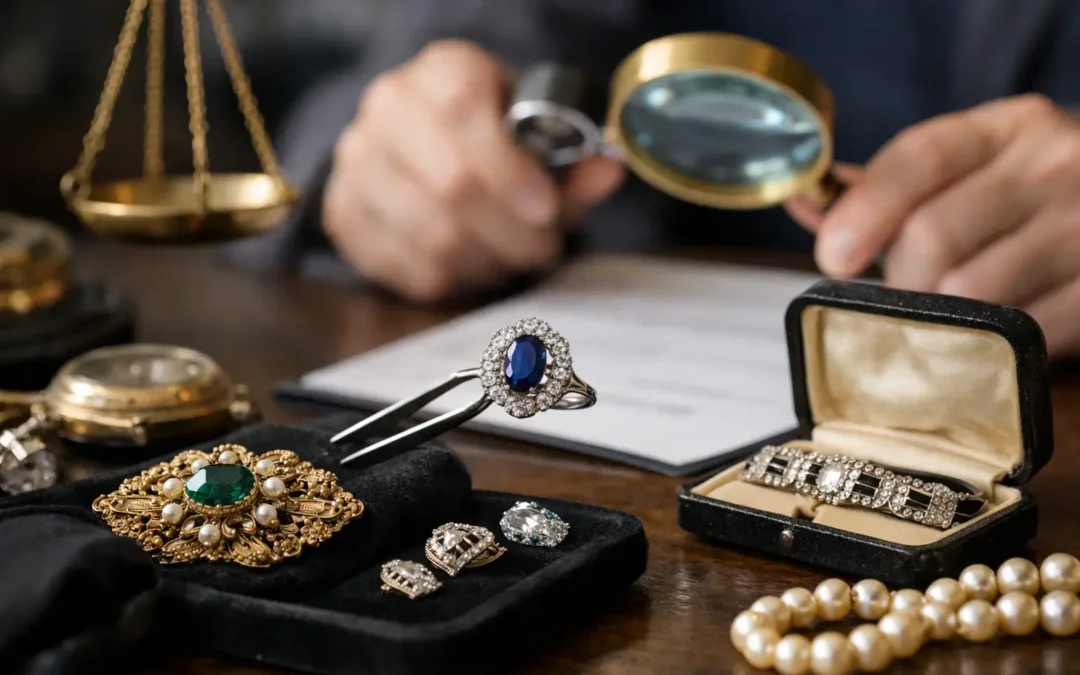
A Victorian brooch found in a jewellery box may be worth its gold weight, several hundred pounds as a well-made period piece, or considerably more as a signed jewel with exceptional stones. Knowing how to value antique jewellery begins with understanding that age alone does not create value. Materials, workmanship, condition, maker, provenance and, crucially, current buyer demand all affect the result.
For an owner considering sale, an auction valuation is not simply an opinion on what an item is worth. It is a considered estimate of what informed bidders may pay in a particular market, at a particular time. That distinction matters when making decisions about probate, insurance, division of an estate or sale.
Start with the correct type of valuation
The word ‘valuation’ is used broadly, but the purpose changes the figure. An insurance replacement valuation reflects the likely retail cost of replacing an item through a jeweller, often with an allowance for sourcing and administration. It will normally be higher than an auction estimate.
A probate valuation assesses the open-market value at the date of death. This requires an objective view of what the jewellery might reasonably have achieved between a willing buyer and seller, rather than an optimistic retail figure.
For sale at auction, the relevant figure is an estimate and, in some cases, a reserve. The estimate is a guide based on comparable lots, quality and demand. A reserve is the confidential minimum price agreed with the auctioneer, subject to their terms. Neither should be confused with a guaranteed outcome. Competitive bidding can exceed expectations, but a cautious market or a narrowly appealing piece may produce a more modest result.
How to value antique jewellery: examine the object first
Begin by looking closely, preferably in good natural light, without attempting repairs or cleaning. Photograph the front and back, any hallmarks, signatures, damage and distinctive details. Keep associated boxes, certificates, old receipts, letters and family records together with the item. A period box is not proof that a jewel was originally supplied in it, but it can still add presentation value and may support a history of ownership.
Metal, hallmarks and construction
The precious metal content establishes a base level of value, but it rarely tells the whole story. Gold, platinum and silver should be assessed for fineness, weight and condition. British hallmarks can identify the assay office, standard mark and, where legible, a date letter. Foreign marks, maker’s marks and import marks may be equally useful.
An unhallmarked jewel is not necessarily of little consequence. Earlier jewellery, altered pieces and items made overseas may lack a conventional British hallmark. A specialist will consider testing, construction and wear before reaching a view. Do not scratch-test or use home acid kits on a potentially valuable antique item, as damage can reduce its appeal.
Construction offers clues to both age and quality. Hand-cut settings, closed-back gemstones, repoussé work, cannetille decoration, articulated links and carefully made clasps may indicate period manufacture. Conversely, later fittings, replacement stones and extensive alterations can affect originality. Such changes are not always negative: a wearable conversion may attract buyers, but it should be described accurately.
Gemstones: quality is more than the name
A diamond, sapphire, ruby or emerald does not carry a fixed value merely because of its species. Size, colour, clarity, cut, treatment and condition must all be considered. In antique jewellery, the cut itself can be significant. Old mine-cut and old European-cut diamonds may appeal to collectors for their distinctive character, even where their proportions differ from modern brilliant cuts.
Coloured stones require particular care. A ruby or sapphire may have been heat treated, and emeralds commonly have clarity enhancement. These matters can materially affect value, but they cannot reliably be settled from a photograph or a casual inspection. Where the potential value warrants it, laboratory evidence may be appropriate. It should be obtained on specialist advice, as the cost and delay are not justified for every lot.
Pearls also demand caution. Natural pearls can be highly valuable, while cultured pearls are more common. Their distinction generally requires expert examination, and occasionally laboratory testing. Uniform strands of cultured pearls may still sell well if lustre, size, condition and presentation are strong.
Condition, completeness and wearability
Condition is a commercial consideration, not a minor footnote. Look for chipped stones, worn claws, damaged enamel, solder repairs, thinning shanks, missing links and replacements. A jewel may need restoration to be wearable, but the cost of work and any loss of originality need to be weighed against the likely uplift in price.
Do not assume that polishing or resetting will improve a sale result. Removing a desirable patina, replacing an old-cut diamond with a modern stone, or updating a clasp without retaining the original can weaken collector interest. A specialist can advise whether light conservation, repair or sale in untouched condition is the sensible route.
Identify period, maker and provenance
The broad period helps place a jewel in the right market. Georgian jewellery is relatively scarce and often valued for its craftsmanship and survival. Victorian jewels range from widely available mourning brooches to fine archaeological revival and high jewellery examples. Edwardian and Art Nouveau pieces can command strong interest where design and quality align, while Art Deco jewellery remains particularly sought after for its geometry, platinum work and calibre-cut stones.
Attribution to a recognised maker can substantially change an estimate. Signed pieces by houses such as Cartier, Van Cleef & Arpels, Boucheron, Tiffany & Co. or Bulgari attract international attention, but a signature must be carefully examined. A worn mark, a later inscription or a branded box does not by itself establish authorship.
Provenance can also strengthen a consignment. Documentary evidence connecting a jewel to a notable owner, important collection or original purchase is more persuasive than family recollection alone. Even without celebrity association, an original fitted case, matching suite or contemporary photograph can make an item more compelling to bidders.
Compare auction evidence, not asking prices
Online searches can be useful, but asking prices from dealers and online marketplaces are not auction results. They may remain visible for months precisely because the item has not sold. The most relevant evidence is a record of comparable sold lots, adjusted for date, condition, stone quality, maker and the sale venue.
Comparisons must be genuinely close. A 1920s diamond ring set with an old-cut stone cannot be valued accurately by reference to a modern ring of the same weight. Similarly, a modestly sized signed Art Deco brooch may outperform a larger unsigned example because its design, provenance and buyer audience are stronger.
Market demand also changes. Fine signed jewellery and scarce period pieces can attract deep competition, particularly when offered with good cataloguing and clear photographs. More conventional yellow-gold jewellery may be influenced more heavily by metal value. Jewellery with small diamonds, damaged coloured stones or unfashionable designs may have a limited collector market despite considerable original cost.
When a professional appraisal is necessary
A specialist appraisal is advisable where jewels contain substantial diamonds or coloured stones, bear signatures or unusual marks, appear to be Georgian or early Victorian, have links to a known maker or family history, or form part of an estate. It is also prudent before agreeing to an offer from a buyer, particularly if the offer is based only on scrap-metal weight.
For sale, provide the jewellery as found, along with every relevant document and box. Avoid separating suites, removing stones or accepting a repair quotation before receiving advice. A pair of earrings, necklace and bracelet from the same design may be worth more when kept together, while a large collection may benefit from being divided into carefully judged auction lots.
At John Nicholson’s, jewellery is assessed with the auction market in view: what the object is, how it should be catalogued, which evidence supports it and where bidder interest is likely to sit. That approach gives sellers a practical basis for deciding whether to consign, retain or insure an item.
The most valuable step is often the simplest: pause before selling. A clear hallmark, an old case or an overlooked maker’s mark can turn an ordinary-looking jewel into a lot that deserves proper specialist attention.