
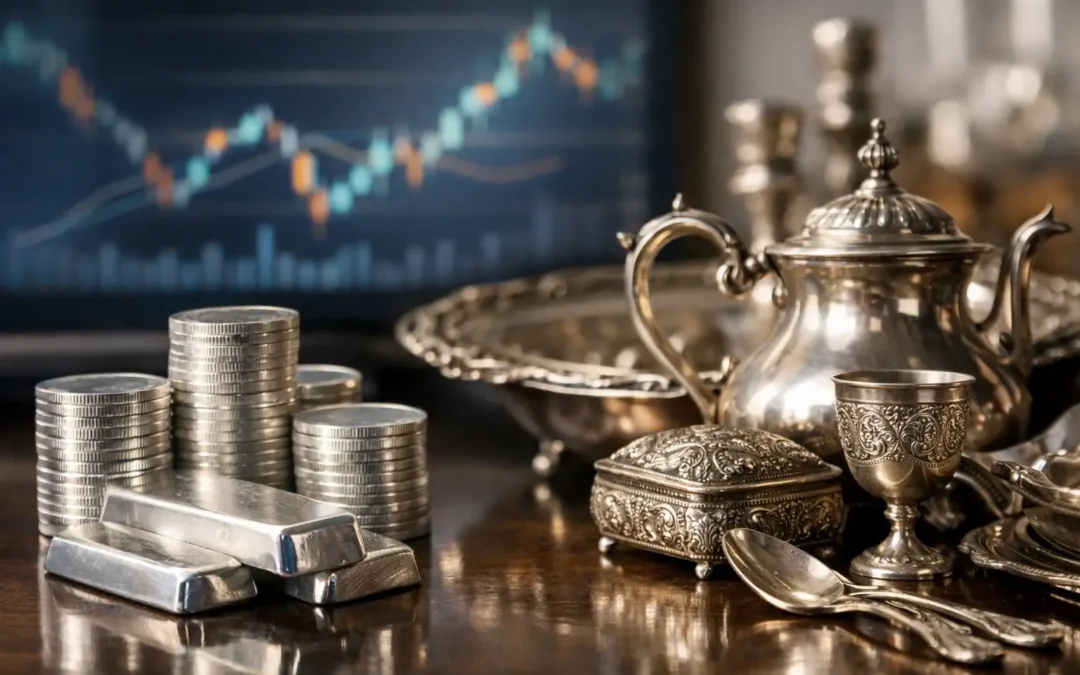
A rise in silver prices may prompt a useful question when clearing a house, administering an estate or reviewing a collection: is this silver worth selling now? The answer is rarely found by weighing it alone. For a modern silver ingot or a damaged, unmarked article, the precious-metal price may be the principal guide. For antique and collectable silver, however, craftsmanship, maker, age, rarity, provenance and condition can matter considerably more.
That distinction is central to a proper auction valuation. A well-made Georgian coffee pot, an Arts and Crafts spoon set or a piece by a desirable twentieth-century silversmith should not be treated as scrap merely because it bears a sterling hallmark. Equally, not every silver-plated tray or heavily worn tea service will command a premium beyond its practical decorative appeal.
What silver prices actually measure
The quoted silver price is the value of silver as a raw commodity, generally expressed by weight. It responds to global trading, currency movements, industrial demand, investment flows and expectations around inflation and interest rates. Silver is used extensively in industry as well as jewellery, tableware and bullion, so its market can move for reasons that have little connection with the antiques trade.
For UK sellers, the sterling value also changes with the pound’s relationship to the US dollar, in which precious metals are commonly quoted. A headline increase in the international silver price does not always translate directly into the same increase for a British seller.
Most importantly, the spot price is not an auction estimate. It is a starting reference for the metal content of an object, not a measure of its historical or collector value. Auction results reflect the willingness of several informed buyers to compete for a particular lot on a particular day.
Silver prices versus auction value
At auction, silver falls broadly into three categories. The first is bullion or near-bullion material, where weight and fineness have the strongest bearing on value. The second is ordinary domestic silver, including many Victorian and twentieth-century items, where usable form, condition and the current market for dining silver influence the result alongside the metal value. The third is specialist silver, where the object may be valued primarily as an example of a named maker, period or design movement.
A plain set of late twentieth-century candlesticks, for example, may be closely tied to silver weight, especially if the market is well supplied with similar examples. A rare seventeenth-century provincial spoon, by contrast, may attract collectors because of its unusual assay office mark, date letter and survival. Its value may bear little resemblance to the melt figure.
There are also practical complications. Many candlesticks, knife handles and weighted bases are not solid silver throughout. They may contain resin, cement, steel fittings or other materials. Hollowware may have repairs that affect desirability. A gross weight taken on kitchen scales can therefore produce a misleading scrap calculation.
Hallmarks establish more than purity
British hallmarks are one of the great strengths of the silver market. They can identify the standard of fineness, assay office, date and, often, the maker’s mark. Reading them accurately can turn an apparently routine object into a recognisable and marketable piece.
Sterling silver is commonly marked 925, but antique British silver may show symbols rather than a numerical standard. The lion passant is familiar on English sterling silver, while other marks can indicate Britannia standard, imported silver or different national systems. A complete set of legible marks is particularly helpful when cataloguing an object for sale.
A hallmark is not, by itself, a guarantee of high value. It must be considered with the quality of the object, its period, the reputation of the maker and the strength of buyer demand. Nevertheless, it is often the first evidence a valuer will wish to inspect.
What adds value beyond the metal
The finest results tend to arise where several favourable factors meet. A respected maker is one. Names such as Paul Storr, Paul de Lamerie, Omar Ramsden, Hester Bateman and Georg Jensen carry strong recognition, although the precise model, date and condition remain decisive. Provincial makers can also be keenly sought after, particularly when their work is scarce or clearly attributable.
Design is equally important. Georgian silver, Arts and Crafts work, Art Deco cocktail wares and distinctive post-war modernist pieces all appeal to different audiences. A practical object with elegant proportion and a strong original surface can outperform a larger but commonplace piece. Sets are usually more attractive when complete: a matching tea service, a coherent collection of spoons or a pair of candlesticks is easier for a buyer to acquire and display than disconnected individual pieces.
Provenance can provide a further advantage. A documented connection to a notable family, collection, commission or historic house may widen interest, provided the evidence is credible and accompanies the lot. Inheritance alone is not provenance in the auction sense, but family records, old photographs, receipts and previous catalogues can be valuable supporting material.
Condition requires measured judgement. Light wear consistent with age is expected on many antique pieces and can be preferable to over-polishing. Serious dents, splits, erased crests, thinning, poor repairs and replacement parts can reduce value. Removing an engraving is seldom a simple improvement: it may leave a thin or uneven surface and diminish an object’s integrity.
Before selling silver from a house or estate
Do not polish old silver aggressively before seeking advice. Harsh abrasives, machine polishing and chemical dips can remove desirable surface detail, soften crisp decoration and leave residue in chased or engraved areas. A gentle dusting and careful handling are normally sufficient until the items have been examined.
Keep matched services together, including knives, cases, spare pieces and any accompanying paperwork. A single missing teaspoon may affect the appeal of a set, but it is still better to present the group honestly than to separate it prematurely. Photograph hallmarks, inscriptions and maker’s marks if an initial remote opinion is needed, but a physical inspection is preferable for significant pieces.
It is also sensible to separate clearly marked silver from silver plate. Electroplated nickel silver, often marked EPNS, contains no solid silver content. It may still have decorative or collector appeal, particularly where quality, maker or design warrants it, but it should not be valued by reference to silver prices. Sheffield plate is a different historical category and can be collectable in its own right, especially in earlier, well-preserved examples.
For executors and families handling an estate, a formal written valuation may be appropriate before sale. This can be distinct from an auction estimate, which is a guide to the likely hammer-price range. The right approach depends on the purpose of the valuation, the scale of the estate and the nature of the objects involved.
When auction is the right route
Auction is particularly effective where silver has a clear maker, an appealing design, good condition or a meaningful group value. It exposes a lot to specialist collectors, dealers, decorators and international online bidders, allowing competition to establish the market level. This is often preferable to a simple metal-buying offer for pieces with artistic or historic merit.
There are trade-offs. Auction estimates must be realistic, and a sale result is not guaranteed to exceed an immediate bullion offer for every object. Commission, photography, insurance and sale timing form part of the process. Yet for the right material, careful cataloguing, accurate attribution and access to the appropriate bidding audience can create value that a weight-based transaction misses.
At John Nicholson’s, silver is assessed as an object before it is assessed as a weight. That means looking closely at marks, construction, condition, design and the likely field of buyers, then advising on the most suitable sale strategy.
If silver is sitting unused in a cabinet, wrapped in a drawer or mixed among the contents of an inherited home, resist the urge to reduce it to a number on a commodities chart. Set aside the pieces, preserve their context and have the hallmarks and workmanship examined. The difference between scrap and a worthwhile auction lot is often found in the details.