
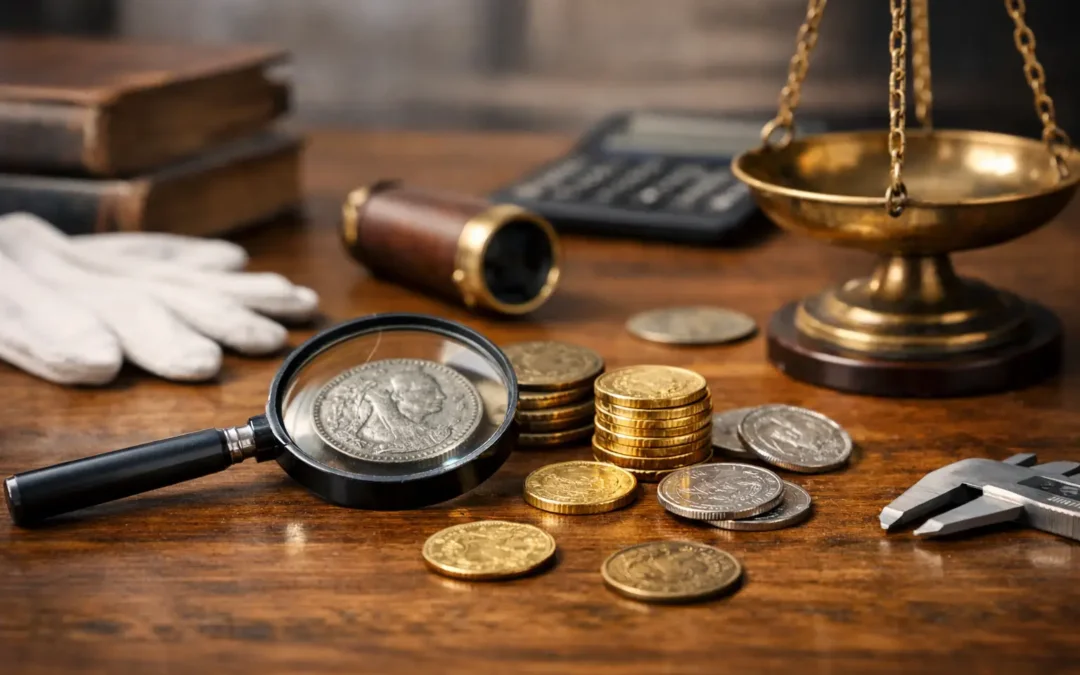
A tray of old coins can look deceptively straightforward. Yet a single date, mint mark, edge inscription or small detail in the portrait may separate a modest collector’s piece from a coin that warrants specialist interest. A proper coin valuation for auction is therefore not a matter of weighing the silver and applying a price list. It is an assessment of exactly what the coin is, how it has survived, and who may wish to bid for it.
For owners dealing with an inherited collection, a house clearance or a long-held accumulation, the first decision is often whether the coins should be sold individually, in carefully arranged groups, or as one collection. The right answer depends on the material. Auction value is created not only by rarity, but by accurate cataloguing, presentation and access to the appropriate market.
What a coin valuation for auction actually assesses
The starting point is attribution. This means identifying the issuing authority, denomination, date, mint, ruler or monarch, and the particular variety where one exists. Ancient and medieval coins require particular care, as inscriptions may be incomplete and types can be closely related. For British milled coinage, a small change in die, mint mark or date can have a material effect on desirability.
Condition follows closely behind attribution. Coins are usually considered in terms of their degree of wear, preservation of detail, lustre, strike and any signs of cleaning, damage, corrosion or alteration. A scarce coin in heavily worn condition may still attract interest, but a well-preserved example often commands a substantial premium. Conversely, an apparently bright coin that has been harshly polished may be less appealing to experienced collectors than a naturally toned example with honest circulation wear.
Rarity must be considered in market terms rather than simply assumed from age. Many Roman coins are ancient but relatively available; some twentieth-century British issues are considerably scarcer than their modern appearance suggests. A coin’s survival rate, the number likely to be offered in a given year, and the quality of comparable examples all matter.
Provenance can also influence value. Coins from a documented old collection, a recognised cabinet or a reputable earlier sale may inspire confidence, particularly where rare ancient, British hammered or high-grade modern pieces are concerned. Provenance is not merely a pleasing story. It can support authenticity, establish collecting history and distinguish an object in a competitive market.
Why face value and bullion value are rarely enough
Gold and silver coins have an underlying metal value, which provides a useful reference point. A sovereign, for example, contains a known quantity of gold, while pre-1920 British silver has a higher silver content than later sterling issues. However, bullion is only one part of the equation.
A common gold sovereign in worn condition may trade close to its gold value, subject to market conditions and buyer demand. A scarce date, branch mint issue or proof sovereign can be worth far more. The same principle applies to silver crowns, commemorative issues and world coins. Treating every gold or silver coin as scrap before it has been examined can result in a missed opportunity.
Base-metal coins should not be overlooked either. Copper and bronze pieces can be rare, and certain decimal errors, proof issues or low-mintage varieties carry collector value well beyond their denomination. Even a mixed tin of pennies, sixpences and foreign currency may contain material that benefits from sorting before a sale strategy is decided.
Condition is not simply about looking new
Owners often assume that a coin should be cleaned to make it more attractive. In most cases, this is unwise. Cleaning can remove original surfaces, soften detail and leave fine scratches that are immediately visible under magnification. The resulting loss in collector appeal may be permanent.
Natural toning, often seen as grey, gold, blue or iridescent colour on silver, can be desirable. So can the even surface of a coin that has been carefully kept but not interfered with. Condition should be judged according to the coin’s age and type. A seventeenth-century hammered shilling cannot be assessed by the same visual standard as a modern proof set in its original Royal Mint case.
Packaging, certificates and old envelopes may also be relevant. They can help establish how a coin was acquired or retained, and original presentation cases can add appeal for proof and commemorative issues. Keep these items with the coins, even if the handwriting or paperwork initially appears unimportant.
Individual lots, groups and complete collections
The structure of an auction entry has a direct bearing on its outcome. A clearly identifiable rare coin, a strong run of sovereigns or a desirable medallic issue will usually justify an individual lot. This gives the catalogue description room to set out the details that serious bidders need and allows competing collectors to focus on the item.
Coins of broadly similar character and lower individual value are often better arranged in groups. This may include mixed world silver, accumulated British pre-decimal currency, assorted commemoratives or a run of circulated copper. Grouping reduces catalogue costs and reflects how many buyers prefer to purchase such material.
A collection with a coherent theme deserves special consideration. It may be a cabinet of coins of the Roman Empire, a date run of Victorian pennies, tokens from a particular county, or medals connected with a military family. Breaking it up can maximise returns when the individual coins are strong, but retaining the collection intact may appeal to a buyer who values its formation and scope. There is no automatic rule. The decision should follow the quality, repetition, condition and likely buyer base.
Evidence that helps the valuer
Before arranging a valuation, avoid sorting coins by appearance alone or removing labels from old trays and albums. The following information can make examination more efficient:
- original boxes, cases, tickets, certificates and purchase invoices
- any previous auction catalogues or valuation documents
- details of where and when the collection was acquired
- photographs of the collection as found, particularly where it has been stored in cabinets or albums
Do not worry if this material is incomplete. Most collections arrive with little documentation, and coins can still be assessed on their own merits. The point is to preserve any information that may assist identification or provenance.
It is also sensible not to post potentially valuable coins without first taking advice on transport and insurance. For substantial collections, an in-person appointment provides the opportunity to examine pieces under suitable lighting and magnification, test weights where appropriate, and understand the collection as a whole.
Auction estimates and reserves
An auction estimate is a considered guide to the likely hammer-price range, based on recent market evidence, condition, rarity and the auction house’s view of bidder appetite. It is not a guaranteed selling price, nor is it the final amount received by a consignor after agreed charges.
A reserve, where appropriate, is a confidential minimum price below which the lot will not be sold. Reserves can give reassurance, especially where a family is reluctant to part with a significant inherited item. However, an unrealistic reserve can deter bidding or leave a coin unsold despite genuine interest. A commercially sound reserve should reflect the evidence, not an exceptional result achieved by an unusually fine comparable coin.
The strongest results often come when the estimate is credible enough to attract attention from the outset. Competitive bidding is driven by confidence: clear images, precise descriptions, accurate grading language and a well-chosen sale all encourage buyers to participate.
Timing and the right market matter
Coins benefit from being offered in a sale where specialist buyers expect to find them. A focused coins, medals and collectables auction allows a collection to be properly catalogued and marketed alongside related material. It can also reach bidders beyond the saleroom through established online platforms, which is particularly valuable for world coins and specialised collecting fields.
Market conditions do vary. Bullion movements affect gold and silver material, while collector demand can strengthen around particular areas such as British milled coins, military medals or Chinese cash. It is sometimes sensible to sell promptly, particularly when an estate requires settlement. At other times, holding a coin for a suitable specialist sale may be the better route. The valuation should explain that judgement clearly rather than promise a fixed outcome.
At John Nicholson’s, coins and medals are assessed with the same attention given to any specialist consignment: identify the material correctly, establish its saleable qualities, and place it before informed bidders. For a seller, the most useful first step is simple: leave the collection as found, retain its paperwork, and have it examined before making any decision about cleaning, splitting or selling.