
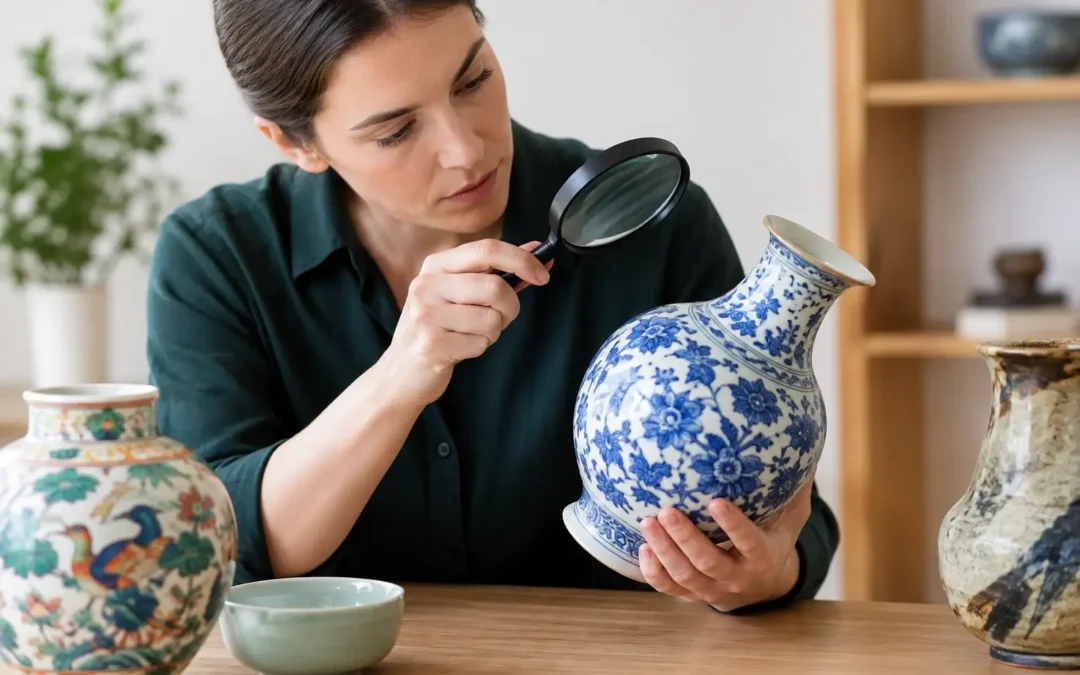
A modest-looking teabowl can be more significant than an imposing cabinet full of modern china. The difference is rarely obvious at first glance. Knowing how to identify auction-worthy ceramics means looking beyond whether an object is simply old, attractive or complete. At auction, value is shaped by maker, date, rarity, condition, provenance and, crucially, the strength of current demand.
For families sorting an estate, collectors refining a cabinet, or homeowners preparing to downsize, a measured first assessment can prevent an important piece being overlooked. It can also prevent unrealistic expectations where attractive domestic ware has limited market interest. The aim is not to establish a final value at the kitchen table, but to recognise the objects that justify specialist attention.
How to identify auction-worthy ceramics: start underneath
The base is often the most informative part of a ceramic object. Turn it over carefully and look for a factory mark, painted signature, impressed name, date code, pattern number, retailer’s stamp or collector’s label. Photograph every mark clearly, including faint impressed lettering that may only appear under raking light.
A mark does not automatically make a piece valuable. Many well-known factories produced wares in large quantities over long periods. However, it provides a starting point for identifying origin and date. Marks associated with early or sought-after periods of Worcester, Derby, Chelsea, Bow, Meissen, Sèvres, Royal Crown Derby, Doulton, Moorcroft and leading Chinese factories may warrant closer consideration, particularly where the form and decoration are consistent with desirable production periods.
Unmarked objects should not be dismissed. Early English porcelain is frequently unmarked, while Chinese, Japanese and Islamic ceramics may rely on reign marks, painted symbols, glaze, footrim construction and decorative vocabulary rather than a straightforward factory stamp. Conversely, a familiar-looking pseudo-mark may be later, decorative or deliberately misleading. It must be read in context, not treated as proof on its own.
Examine the object, not just the name
Auction specialists assess a ceramic piece as a whole. A recognisable maker can be useful, but the particular model, shape, decoration and period of manufacture often determine whether bidders will compete for it.
Age and method of manufacture
Hand-painted decoration will usually show small variations in line, colour and placement. Transfer-printed wares tend to repeat a design with greater regularity, although hand colouring may have been added afterwards. Neither method is inherently better: a rare transfer-printed documentary mug can command strong interest, while a later hand-painted ornamental plate may not.
Look at the footrim and glaze. Signs of hand-finishing, kiln grit, unevenness or age-related wear can help build a picture of manufacture, but they are not conclusive. Old-looking damage can be artificial, and some genuinely early ceramics were made to a remarkably high standard. Avoid cleaning, polishing or attempting repairs before an expert has seen the piece. A well-meaning intervention can obscure evidence and reduce saleability.
Form and decoration
Certain forms are consistently more desirable than others. A complete early tea or coffee service, an unusual figure, a large charger, a rare vase shape, a named pattern or a commemorative mug with local historical relevance may attract interest beyond its decorative appeal.
Decoration should be examined for quality and specificity. Detailed botanical painting, finely modelled figures, ambitious landscape scenes, armorials and unusual colour palettes can all matter. For Chinese ceramics, the quality of painting, tone of glaze, composition, porcelain body and the relationship between mark and period are more useful indicators than subject matter alone. Blue and white decoration is widely copied across centuries, so a dragon or a four-character mark is never sufficient evidence by itself.
Sets require a practical judgement. Six matching cups and saucers may be more commercially attractive than a single example, but only if they are genuinely matching and in acceptable condition. A service assembled over decades, with subtly different dates, colours or marks, should be described accurately rather than presented as original.
Condition can change the estimate substantially
Ceramics are fragile, and condition is often the dividing line between an appealing object and an auction lot with limited demand. Inspect under good natural light and run a fingertip gently around rims, handles, spouts, finials and the edges of applied decoration. Listen for a dull sound when lightly tapped only if the piece can be handled safely – this is not a definitive test, but it may reveal an issue worth examining.
Pay particular attention to hairline cracks, chips, restored breaks, rim grinding, staple repairs, discoloured glue, overpainting and replacement parts. A restored cover on a rare eighteenth-century tureen may be acceptable to the market. The same restoration on a common nineteenth-century vase may make it difficult to sell. Rarity and desirability can outweigh condition concerns, but only to a point.
Do not confuse manufacturing faults with later damage. Firing cracks, kiln marks and glaze imperfections may be original to the production process. Crazing is also common, especially on older earthenware, and its effect on value depends on severity, visibility and the type of object. A specialist will distinguish these details and describe them properly in a catalogue condition report.
Provenance gives an object authority
Provenance is the documented history of ownership. It may take the form of an old invoice, collection label, exhibition catalogue, family inventory, correspondence or a photograph showing the ceramic in a known interior. Even a handwritten note can be useful if it supports a wider history.
This evidence is particularly valuable for pieces attributed to important makers, objects with royal, aristocratic or institutional ownership, and ceramics acquired from respected dealers or historic collections. Keep associated paperwork together, but do not attach labels, tape or stickers directly to the object. Photograph labels in situ before removing anything loose.
Family stories should be recorded as well. They are not a substitute for documentary proof, but details such as where the item was acquired, who owned it and how long it has been in the family can assist research. A vase said to have been bought in Shanghai in the 1930s requires careful scrutiny, yet that information may still be relevant when considered alongside the object itself.
Distinguish decorative appeal from auction demand
The auction market is not a simple hierarchy in which older always means better. Some Victorian ceramics remain highly collectable, while others were produced in great volume and appear regularly at sale. Likewise, mid-century studio pottery can attract determined buyers when it is by a recognised potter, has an exceptional glaze or comes from an important collection.
Demand is influenced by scarcity, collector fashion, interior taste and international buying patterns. High-quality Chinese ceramics, important European porcelain, rare English pottery, Arts and Crafts wares and leading studio ceramics can all perform strongly, but the market is selective. A maker’s best period, a rare pattern, an unusual size or excellent untouched condition can matter more than the name alone.
Be cautious with online price comparisons. Retail asking prices are not auction results, and one exceptional sale does not establish a value for every similar item. Auction estimates reflect what informed buyers are likely to pay in a competitive sale, allowing for condition, market supply and the precise quality of the individual object.
Prepare a ceramic for valuation
If a piece appears promising, take clear photographs before moving it. Include front, back, base, interior, all marks, close-ups of decoration and any damage. Measure height and diameter, and note how many pieces are in a set. Gather invoices, old valuations and any collection records, but do not rely on earlier valuations as a current guide: tastes and prices change.
Do not wash away dust from crevices, scrub gilding, use adhesive on a loose fragment or attempt to remove old labels. Place small pieces separately in tissue, avoiding newspaper directly against glazed surfaces, and keep lids with their matching bases. Where there is a quantity of ceramics, photograph the group before separating it. The arrangement may reveal that items belong to a service or collection.
A professional valuation is most useful when it considers the object in person, or from detailed images where necessary, alongside current comparable auction evidence. At John Nicholson’s, ceramics can be assessed within the wider context of a house clearance, inheritance or single-owner collection, helping sellers decide whether an item belongs in a specialist sale or should be grouped more practically.
The most worthwhile ceramics often reveal their quality slowly: in a finely painted border, an unfamiliar impressed mark, a weighty porcelain body or an old label that has remained with the piece for generations. Preserve those clues, resist quick repairs, and seek informed advice before deciding what is merely household china and what deserves a place in the saleroom.
