
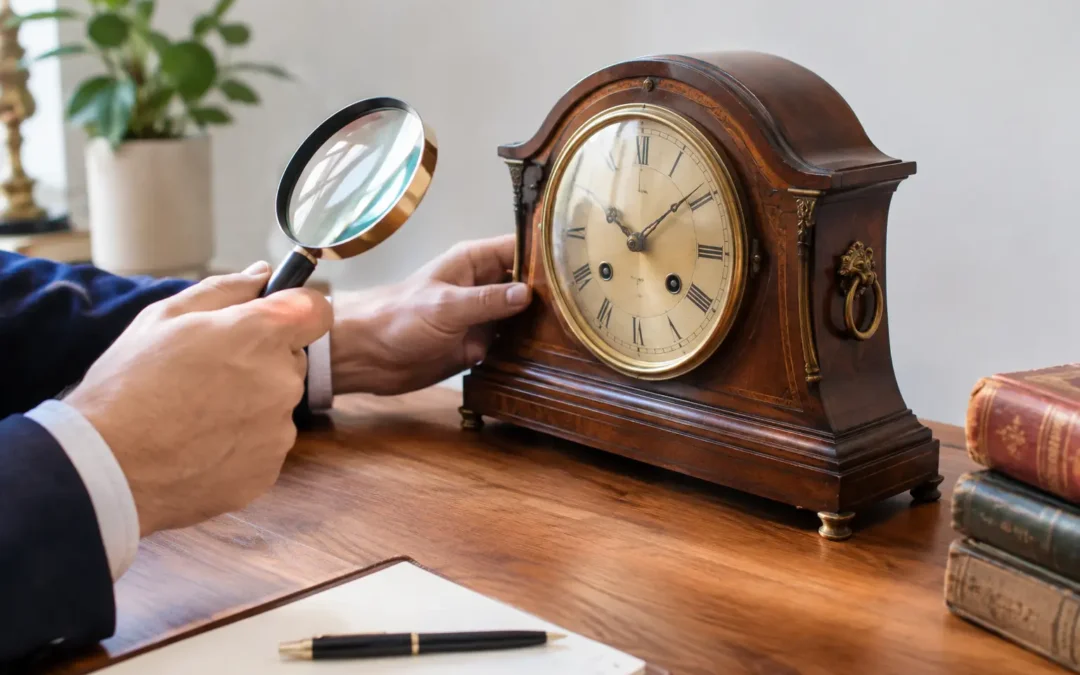
A clock may have stood quietly on a mantelpiece for generations, but its value is rarely quiet or straightforward. Antique clock valuations require more than an assessment of age and appearance. The maker, movement, originality, condition and present buying appetite can each alter the likely result substantially. A handsome clock case does not necessarily indicate a valuable timepiece, while an unassuming bracket clock with a distinguished movement may command serious attention in the saleroom.
For owners considering sale, a proper valuation establishes what the clock is, how it should be described and where it sits in the current market. That distinction matters, particularly when a clock forms part of an estate, an inherited collection or a wider house clearance.
What an antique clock valuation is intended to establish
The first question is not always, “What is it worth?” It is often, “Worth for what purpose?” An auction valuation, an insurance replacement valuation and a probate valuation are prepared for different reasons and can produce different figures.
An auction estimate reflects the likely hammer price in a competitive sale, based on comparable results, condition and the number of buyers likely to pursue the piece. It is not a guaranteed price, nor does it include the buyer’s premium paid by the successful purchaser. A reserve, where appropriate, is then agreed separately between seller and auctioneer.
An insurance valuation usually reflects the retail replacement cost of finding a similar item through a specialist dealer. It will commonly be higher than an auction estimate. Probate valuations have a different purpose again: they should reflect the open-market value at the relevant date of death. Using an insurance figure for probate, or assuming an old insurance schedule represents an achievable sale price, can lead to unrealistic expectations.
The details that drive antique clock valuations
A specialist starts with the clock itself, rather than its family story. The case, dial, hands, movement, striking train and any associated accessories all need to be considered together. A clock that has become a composite over time – for example, with a later movement in an earlier case – may still be attractive, but it should not be valued as a wholly original example.
Maker, place and period
Named makers are an important starting point. English clockmakers such as Thomas Tompion, George Graham, Daniel Quare and the Knibb family occupy the highest levels of the market, but a maker need not be famous to be desirable. A well-made signed longcase clock from a respected provincial maker can have considerable regional and collector appeal, particularly where the dial, case and movement remain together.
Place of manufacture matters too. London-made clocks often attract strong interest because of the city’s historic importance to clockmaking, but quality examples from provincial English workshops, France, Austria, Germany and the Low Countries have their own markets. A late 19th-century French ormolu and porcelain clock may appeal to a decorative interiors buyer, whereas a restrained 18th-century bracket clock is more likely to be judged closely by a horological collector.
Age alone is not enough. Many early clocks have been altered, heavily restored or replaced in later cases. Conversely, a 20th-century clock by a recognised maker, or a high-quality Art Deco design, may be worth more than a more common Georgian piece.
The movement is central to value
The movement is the working heart of a clock and frequently its most revealing component. Its construction, engraving, escapement, repeat mechanism, striking arrangement and apparent originality help determine both significance and desirability. A quarter-repeating bracket clock or a fine three-train longcase clock may attract interest beyond that of a standard time-and-strike model, provided the work is authentic and competently preserved.
Complications can add value, but only where they are original, complete and functioning. Calendar work, alarm mechanisms, musical features, automata and astronomical indications all require careful examination. A clock described as having a repeating or musical movement that does not operate may need a more cautious estimate, even if restoration is possible.
It is also worth remembering that a clock need not be running at the time of inspection to have value. Many antique movements simply require a careful service. However, evidence of crude repair, corrosion, missing components or substantial wear can affect both the estimate and the confidence of potential bidders.
Originality, condition and restoration
Originality is often where the strongest values are won or lost. Collectors generally prefer a clock that retains its original dial, hands, movement, case finish and fittings, even where there is honest age-related wear. A little patination may be preferable to an aggressively polished brass dial or a case stripped of its historic surface.
That does not mean restoration is always unwelcome. Sensitive, documented work by a capable horologist can preserve a clock’s usefulness and appearance. The difficulty arises when restoration obscures evidence, introduces inappropriate replacement parts or changes the proportions and character of the object. Repainted dials, recut case veneers, later finials and replacement pendulums should be identified rather than overlooked.
There is a commercial judgement involved. Spending heavily to make a clock perfect does not automatically increase the eventual auction result by the same amount. Before commissioning repairs, it is sensible to seek advice on whether the likely uplift in value justifies the cost. In some cases, selling a clock honestly described as requiring attention is the sounder decision.
The case, dial and design still matter
A clock is both a mechanism and an object of furniture or decoration. The quality of the case can make a decisive difference, particularly for longcase, bracket and mantel clocks. Cabinetmaking, veneers, marquetry, lacquer, carving and gilt-metal mounts should all be considered in relation to the period and type.
For longcase clocks, dimensions can influence demand. A fine eight-day movement in an elegant, well-proportioned case may appeal more widely than an imposing example that is difficult to accommodate in a modern home. Tall cases, unusual regional forms and painted dial clocks can all find committed buyers, but condition and presentation remain crucial.
Decorative clocks occupy a market of their own. French empire clocks, Rococo cartel clocks, carriage clocks, skeleton clocks and Art Deco designs may be purchased by collectors, decorators or both. The broadest appeal is not always the highest-value appeal: a specialist rarity may attract fewer bidders, yet achieve a stronger price when the right buyers are engaged.
Provenance and supporting material
Provenance can strengthen a clock’s appeal, especially where it connects the object to a known collection, historic house, notable maker or documented acquisition. Old invoices, repair records, exhibition labels, family photographs and catalogues should be retained. They may help establish how long a clock has remained together, identify earlier restorations or support a more precise attribution.
Family tradition should also be recorded, but treated carefully. A statement that a clock “came from a great house” or “was made for an ancestor” is not the same as verifiable provenance. Auction cataloguing should distinguish between established facts and unsubstantiated history. Serious buyers appreciate clarity, and clear cataloguing protects both seller and purchaser.
Why the market can matter as much as the object
Auction values respond to supply and demand. A clock may have a good published history and a respected maker, yet achieve a modest result if several comparable examples appear in the market at once. Equally, a fresh-to-market clock from a private home, offered with a sensible estimate, can prompt determined bidding when collectors have not seen a similar example for some time.
The route to market matters. Specialist sales bring together informed bidders who understand technical descriptions and condition reports. Online bidding has widened the audience considerably, but it has also made accurate photography, measurements, movement details and a transparent condition report more important. A prospective purchaser in another part of the country, or overseas, must be able to assess the clock with confidence before bidding.
At John Nicholson’s, clock consignments are assessed with the intended sale audience in mind: whether that is a collector-led specialist market, an interiors-focused audience, or a broader antiques sale. This helps determine the estimate, catalogue treatment and the most appropriate sale.
Preparing a clock for valuation or sale
Do not polish, oil or dismantle an antique clock before it has been examined. Well-meaning cleaning can remove original surfaces, while household oil may cause damage within a movement. Keep all related items together, including keys, pendulums, weights, winding cranks, brackets, glass domes and any paperwork.
Photographs are useful for an initial discussion, particularly images of the full clock, dial, movement and any maker’s signature or label. For a longcase clock, include the hood, trunk, base and movement separately where possible. If the clock has faults, describe them plainly. A stopped clock, cracked dial or missing key is not necessarily a reason to dismiss it, but it is material information for valuation.
A sound valuation does not simply attach a number to an old clock. It identifies the features that informed buyers will care about and sets an estimate that invites proper competition. Before deciding whether to restore, insure, divide or sell, let the clock be examined for what it is – not merely for how long it has been in the family.
