
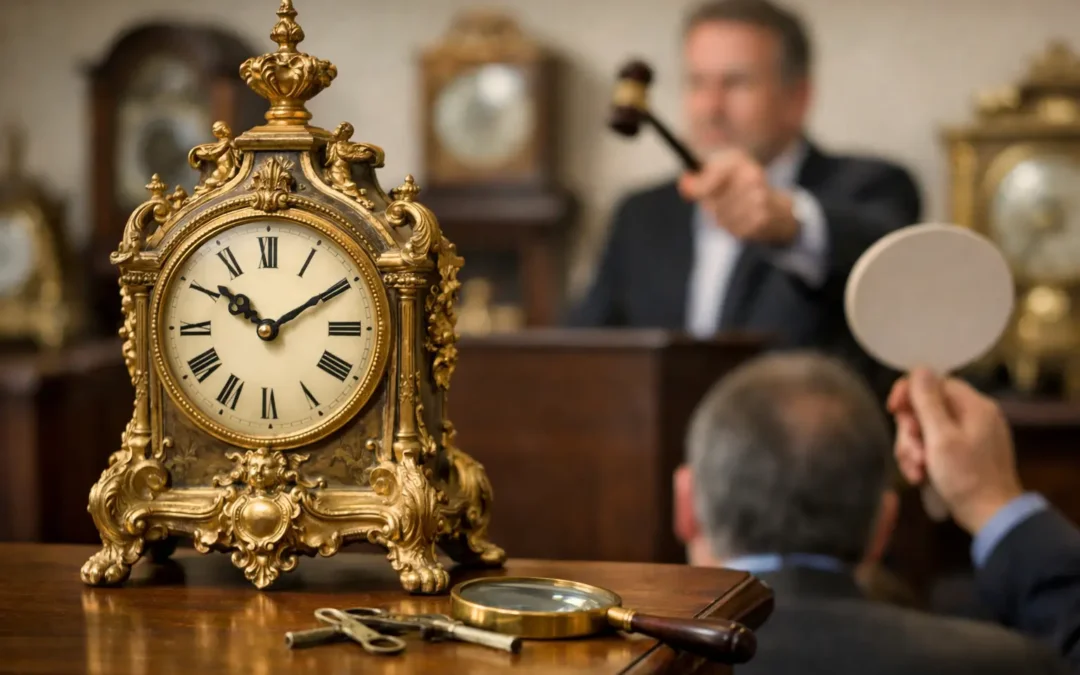
A longcase clock can look like a handsome piece of furniture until the bonnet is opened, the dial examined and the movement taken seriously. That is usually the point at which the antique clock auction UK market stops being decorative and becomes properly specialist. For sellers, that distinction matters because a clock that appears modest in a hallway may attract determined bidding if the maker, movement, case and condition are right. For buyers, it is the difference between purchasing on appearance and bidding with judgement.
Why an antique clock auction UK sale needs specialist handling
Clocks are not a category that rewards guesswork. A painting may still be sold on school, subject or decorative appeal even if attribution is uncertain. A clock is less forgiving. Value often rests on a combination of maker, period, originality, case quality, dial signature, movement type, striking train and state of repair. Remove one of those strengths and the market response can change quickly.
That is why specialist cataloguing matters. An 18th century longcase by a provincial maker with an associated case is not the same proposition as one retaining its original movement, dial and well-figured case. Likewise, a bracket clock with repeat work, verge escapement and substantial restoration should be described differently from a cleaner example with stronger originality. Buyers at auction read such distinctions closely, particularly those who purchase regularly and know how repair costs can alter the economics of a lot.
At a reputable auction house, clocks are assessed not only as antiques but as mechanisms. That means looking beyond polish and proportions to questions of authenticity, alteration and running order. In practical terms, better examination usually leads to better estimates, more confident bidding and fewer surprises after the sale.
What tends to sell well at antique clock auction UK events
The clock market is broad, and broad markets rarely move in one direction. Some sectors have remained consistently resilient, while others depend more heavily on quality, originality and estimate discipline.
Longcase clocks still attract interest, especially where there is a good maker, attractive case timber, painted or engraved dial appeal, and sensible size for a modern interior. The strongest examples tend to be Georgian and earlier, with regional makers often performing well when properly catalogued. Very large, heavily restored or over-ornamented examples can be harder work unless they are exceptional.
Bracket clocks and table clocks remain a serious collecting field. English examples by recognised London makers, particularly those with repeat or musical features, continue to command attention. Fusee wall clocks, skeleton clocks and lantern clocks also have an established audience, though condition and originality remain decisive. In the twentieth century, certain carriage clocks, regulator clocks and design-led pieces can perform strongly, but here again the trade-off between decorative appeal and technical quality is important.
Buyers are increasingly selective. They may forgive minor wear consistent with age, but they are less relaxed about replaced dials, marriage pieces, major case reconstruction or movements altered beyond easy understanding. A clock does not need to be perfect to sell well, but it does need to be honestly presented.
How values are judged
Auction estimates in clocks should never be treated as a mathematical exercise. Comparable results matter, but so do factors that cannot be reduced to a simple formula.
Maker is often the starting point. Established names, especially those with good recorded histories, usually widen the bidding audience. Period follows closely behind. Early clocks with good untouched surfaces and convincing components tend to carry a premium over later, more common production. Then there is case quality. Oak, mahogany, walnut, japanned and ebonised cases all attract different buyers, and condition of veneers, mouldings and feet can influence confidence as much as appearance.
Mechanical content matters just as much. Eight-day duration, quarter striking, alarm work, calendar mechanisms or repeat functions may add interest, but only if they are original or at least coherently preserved. Provenance can also help, though it is not a substitute for quality. A family history is useful when it supports the object rather than trying to compensate for weakness.
One of the more difficult aspects of clock valuation is restoration. Necessary conservation can preserve value. Excessive intervention can undermine it. A well-cleaned movement and professionally stabilised case may be entirely acceptable. Re-silvered dials, rebuilt hoods, replaced movement parts and aggressively refinished surfaces raise more serious questions. It depends on extent, quality and candour.
Selling through an antique clock auction UK specialist
For sellers, the first practical step is not cleaning the clock or trying to make it run. It is obtaining a proper appraisal. Amateur polishing, over-winding, forcing a seized movement or replacing parts before inspection can reduce value rather than protect it.
A specialist valuation will usually consider the movement, dial, case, dimensions, apparent originality and overall saleability. Photographs can provide a useful first indication, but clocks often need in-person examination. The movement may reveal details not visible from the front, and those details can significantly affect estimate and sale strategy.
The next question is whether the clock belongs in a specialist sale or a broader antique auction. Better clocks nearly always benefit from a setting where they are seen by informed buyers. General sales can work for lower-value examples, decorative clocks or pieces with limited collector demand, but stronger material deserves targeted cataloguing and marketing.
Reserve setting requires judgement. If the reserve is too ambitious, bidding can stall before the room has taken the lot seriously. If it is sensible and aligned with estimate, competition has room to build. Auction houses with real experience in clocks will advise where interest is likely to begin and where caution is warranted.
For executors and families handling estates, there is a further point worth remembering. Clocks are often assumed to be among the most valuable contents of a house simply because they are large, old and mechanically complex. Sometimes that assumption is correct. Often it is only partly correct. The market rewards specific quality, not age alone.
What buyers should examine before bidding
Collectors and private buyers approach clocks with different priorities, but the essentials are similar. Condition reports matter, and so do clear images of dial, case, movement and any damage or alteration. If those details are not available, caution is reasonable.
The first issue is originality. Is the dial right to the movement and case? Are the hands period and appropriate? Does the case appear substantially original? Is there evidence of major rebuilding? The second is condition. Cracks, losses, later feet, replacements to finials, dial damage, altered seatboards and movement wear all affect both value and future cost.
The third issue is practicality. A longcase clock may be attractive at auction, but ceiling height, depth of base and transport requirements need thought. A bracket clock may seem straightforward until one factors in overhaul costs or a missing bracket. Buyers who collect seriously are usually content to accept some faults, provided the estimate reflects them and the catalogue description is candid.
Bidding platforms have widened access to the market, which is good for both vendors and buyers, but online convenience does not remove the need for discipline. It is easy to chase a clock on appearance alone. It is harder, and wiser, to decide in advance what originality, condition and rarity justify.
Why estimates and hammer prices can differ sharply
Clock auctions often produce results that seem surprising to non-specialists. A modest-looking wall clock may exceed estimate comfortably, while a grand longcase may struggle. That usually comes down to audience depth and practical demand.
Smaller clocks are often easier to place in contemporary houses. They are cheaper to transport and, in some cases, easier to maintain. Decorative appeal also plays a larger role in some sectors of the market than purists like to admit. Conversely, a substantial floor-standing clock may be historically superior but limited by space, fashion and restoration concerns.
This is where commercial realism matters. Good auctioneers do not simply admire clocks. They judge who is likely to bid, how widely the lot will appeal and whether the estimate invites participation. In a healthy sale, estimate is not a prediction of certainty but a disciplined guide to market appetite.
Choosing the right auction house
If you are consigning an antique clock, specialist knowledge should outweigh convenience. The right auction house will identify what the clock is, place it in the correct sale, photograph it properly, write a credible catalogue entry and expose it to the broadest suitable bidding audience. That combination is often more important than any single pre-sale opinion.
Established regional firms with regular specialist sales and strong online bidding channels are often well placed to achieve this. John Nicholson’s, for example, operates within that model, combining traditional saleroom practice with access to national and international bidders. For clocks, that reach is useful, but expertise remains the decisive factor.
The best results usually come when sellers are realistic, cataloguing is precise and buyers are given enough information to act decisively. Antique clocks still command respect in the auction room, but respect alone does not create value. Accuracy, presentation and market judgement do. If you are dealing with a clock of any age or apparent quality, start with the object itself – not family legend, not decorative scale, and not assumption.