
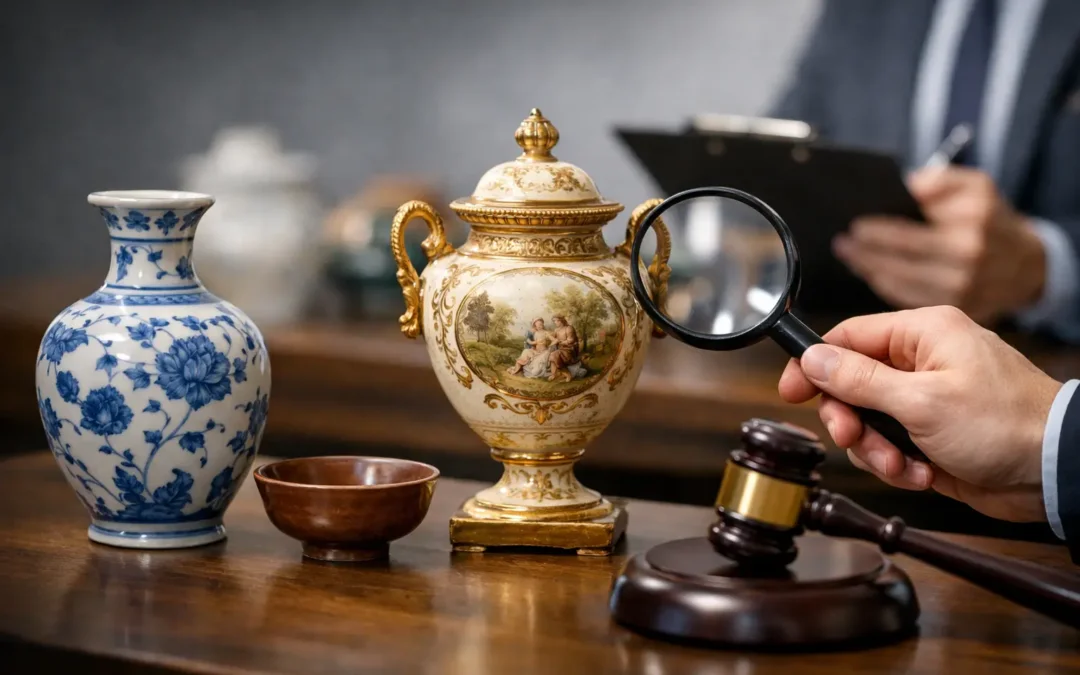
A plate marked Meissen, a studio pot bought in the 1970s, a Worcester tea bowl tucked into a cabinet for decades – ceramics often arrive at auction with more uncertainty than almost any other category. Ceramic valuation for auction is rarely a matter of age alone. Condition, attribution, rarity, decoration, provenance and current buyer demand all carry weight, and small details can move an object from modest household china to a sought-after lot.
That is why ceramics need to be assessed in the round. Two vases may look broadly similar to a non-specialist, yet one may be a later decorative piece and the other a period example with a genuine market among collectors. Auction value depends not only on what an item is, but on who is likely to compete for it in the saleroom and online, and how convincingly it can be catalogued.
What ceramic valuation for auction actually means
In auction practice, a valuation is not an abstract opinion of worth. It is an informed estimate of the price range an object is likely to achieve in the open market, within a specific sale context, at a particular time. That distinction matters. Insurance values, probate figures and retail asking prices are calculated on different bases. An auction estimate is grounded in recent selling evidence, specialist judgement and present demand.
For ceramics, the valuer considers both object scholarship and market behaviour. A piece of 18th-century English porcelain may be academically interesting, but if it has restoration, weak decoration or an unfashionable shape, bidding may remain restrained. Equally, a 20th-century studio ceramic by a recognised maker can outperform older material if collectors are active and supply is tight.
This is where experience counts. Ceramic markets are not uniform. Chinese export porcelain, Staffordshire figures, Delft, Moorcroft, Clarice Cliff, Ruskin, Martinware and contemporary studio pottery all attract different buyers and respond to different market pressures.
How specialists assess ceramics for auction
The first stage is identification. That includes factory or maker, date, place of origin, pattern or series where relevant, and whether the object sits comfortably within the known body of work. Marks are useful, but they are only one part of the picture. Many ceramics are unmarked, wrongly marked or later copied, so shape, paste, glaze, painting style and foot rim construction can be just as revealing.
Condition is then examined closely. In ceramics, value can be heavily affected by chips, hairlines, restoration, repainting and firing flaws. Some defects are acceptable within certain categories. A rare early English porcelain figure with minor professional restoration may still be strongly contested. A common 19th-century cabinet plate with the same issue may lose much of its appeal. The commercial question is not simply whether damage exists, but whether collectors will tolerate it in that particular type of object.
Decoration and craftsmanship also matter. Hand-painted detail, unusual palettes, fine gilding and well-resolved modelling can all strengthen value. So can rarity of form. A familiar pattern in an uncommon shape may interest bidders more than a standard example. Sets raise another question. Completeness may help, but partial services can still sell well if the pattern is desirable and buyers are filling gaps.
Provenance, where available, can assist. A ceramic object from a documented collection, a country house, or with a sound paper trail may inspire greater confidence. At auction, confidence often translates into stronger bidding.
The factors that most affect auction estimates
Ceramic valuation for auction turns on several overlapping factors, and the balance between them is rarely fixed.
Age is one consideration, but not a guarantee of value. Plenty of 18th and 19th-century ceramics survive in quantity, and ordinary examples can be relatively modest. Rarity is more powerful than age when supply is thin and collectors are engaged.
Attribution is equally important. A piece firmly catalogued to a recognised factory or maker will usually attract better attention than one described more cautiously as attributed or in the manner of. The market rewards certainty.
Condition can alter an estimate sharply. A small rim chip on a charger might be less damaging than a restored handle on a porcelain figure, but it depends on rarity, visibility and buyer expectations within that field. Conservative, accurate condition reporting is essential because disappointment after the sale serves no one.
Fashion and collecting trends should not be ignored. Certain traditional areas move steadily but not spectacularly. Others can strengthen quickly, especially where design-led buyers, decorators and younger collectors enter the market. Good studio pottery is a clear example of a field where maker recognition and taste can shift prices materially.
Finally, the sale setting matters. A specialist auction, where the catalogue reaches the right audience, may produce a very different result from a general household sale. Ceramics benefit from careful placement.
Pottery, porcelain and studio ceramics are not valued in the same way
One common mistake is to treat all ceramics as a single category. In practice, the valuation approach differs.
Porcelain is often judged heavily on factory, period, quality of decoration and survival in clean condition. Collectors may be exacting about restorations and replacements, especially in figures, tea wares and garnitures.
Pottery can be more varied. Some buyers are drawn to vernacular charm, regional production or decorative strength rather than technical perfection. A slipware dish, a piece of art pottery or a Victorian majolica jardiniere each speaks to a different market.
Studio ceramics introduce another layer. Here, the maker’s reputation, exhibition history, marks, glaze quality and date within the artist’s career can all be relevant. A bowl by an admired studio potter may carry more value than a larger and older factory-made object. This can surprise families clearing houses, particularly where mid-20th century pieces were bought directly from potteries, craft fairs or small galleries.
How to prepare ceramics for valuation
Good valuation begins with clear information. If you are seeking an auction appraisal, provide straightforward photographs of the whole object, the base, any marks, and any visible damage. Include measurements. A close image of a signature or factory mark is often useful, though specialists will not rely on marks alone.
If you know where the item came from, say so. Was it inherited, bought from a dealer, acquired abroad, or part of a longer-held collection? Even partial provenance can help direct research. Old receipts, labels, exhibition catalogues and family notes may all add context.
Do not clean aggressively before inspection. Over-cleaning can remove surface evidence, wear patterns or residues that help with dating and authenticity. Equally, do not attempt amateur repairs. A glued handle or filled chip usually complicates both valuation and saleability.
Where there is a group of ceramics, resist the urge to assume that the value lies only in the most decorative pieces. Auction houses often find that a quiet-looking bowl, a tea caddy or a single studio vase proves more commercially interesting than a full cabinet of ordinary wares.
Why estimates sometimes differ from expectation
Sellers often compare auction estimates with online asking prices or family assumptions. The gap can be uncomfortable, but it is usually explainable. Asking prices are not sold prices. Retail dealers price for overheads, stock holding and negotiation. Auction estimates are pitched to encourage bidding while remaining credible to the market.
The reverse also happens. A modest estimate can lead to a strong result when several bidders pursue the same lot. That is the advantage of competitive sale. Ceramic valuation for auction is therefore both disciplined and flexible – disciplined because it relies on known evidence, flexible because live demand can exceed expectation.
It also helps to understand that estimate and reserve are not the same thing. A reserve protects the seller at an agreed minimum level, while the estimate guides buyers. Setting either too ambitiously can suppress interest. Serious buyers respond best to sensible cataloguing and realistic expectations.
The advantage of specialist auction handling
Ceramics reward informed cataloguing. Correctly identifying a factory, distinguishing period examples from later reproductions, and writing a description that speaks to collectors can materially affect the outcome. So can photography, lotting strategy and placing the item in the right auction alongside comparable material.
For sellers in the South East, a firm such as John Nicholson’s brings practical value here – regular specialist sales, an established buyer base and the sort of object knowledge that helps separate decorative ceramics from pieces with stronger market significance. That combination of connoisseurship and commercial judgement is what sellers should look for.
Not every ceramic object belongs in a headline specialist sale, and that is part of honest valuation. Some pieces are better grouped, some merit individual lots, and some may have more sentimental than commercial value. Clear advice at the outset saves disappointment later.
If you are considering a sale, the sensible first step is not to guess at value from a backstamp or a search result. It is to have the object looked at properly, with condition, attribution and market demand assessed together. Ceramics can be deceptively simple to the eye, but the market rarely is.