
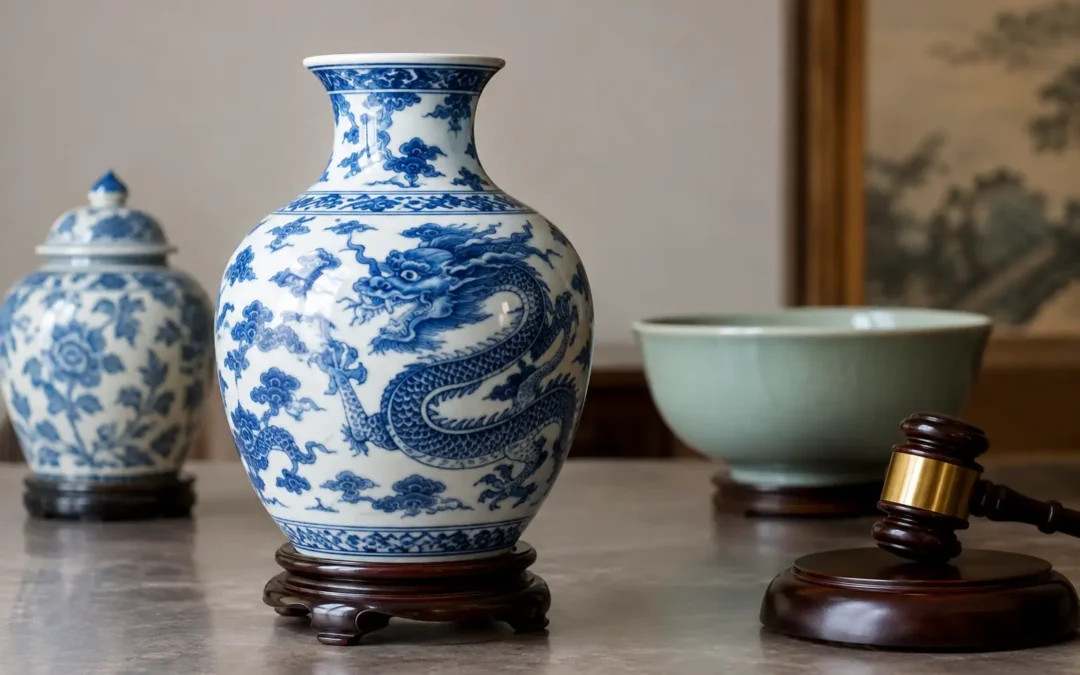
A small porcelain bowl can look unremarkable on a sideboard yet attract determined bidding once its period, glaze and provenance are properly understood. Equally, a decorative vase bearing a familiar reign mark may be a later copy with modest commercial value. Chinese ceramics reward close examination, and the difference between an attractive object and a significant auction lot is rarely decided by age alone.
For owners considering a sale, the first task is not to clean, repair or assign a value from an online comparison. It is to establish what the object is, how it was made, its condition and where it sits within the current market. For buyers, the same discipline helps distinguish genuine collecting opportunities from objects that are simply decorative.
Why Chinese ceramics require specialist assessment
The term encompasses a vast field: early earthenwares, Tang dynasty funerary figures, Song celadons, Yuan blue and white, Ming imperial porcelain, export wares, famille rose enamels, scholar’s objects and twentieth-century production. These categories were made across many centuries, kilns and regions, for domestic, courtly and overseas markets. There is no single rule that applies to all of them.
Material and manufacture provide the starting point. Porcelain, stoneware and earthenware differ in body, firing temperature and finish. A knowledgeable examination considers the weight and feel of the body, the footrim, the colour and pooling of the glaze, decoration, firing marks and signs of age. It also considers whether the form is consistent with the period claimed.
This is where auction experience matters. A six-character Qianlong reign mark, for example, is not in itself proof that a vase was made during the Qianlong period. Marks were copied respectfully, commercially and sometimes deceptively in later reigns. Their calligraphy, position, colour and relationship to the object all require scrutiny.
The periods that shape market interest
Certain periods command particular attention, but rarity and quality are more useful guides than a simple hierarchy of dynasties. Imperial Ming and Qing porcelain can achieve substantial prices where provenance, condition and decoration are strong. Fine Song ceramics are prized for restrained form and exceptional glaze, while Yuan blue and white remains a cornerstone of serious collecting because of its historical importance and scarcity.
Export porcelain has a different but highly active market. Chinese wares made for European clients, including armorial services, tea wares and eighteenth-century famille rose pieces, appeal to collectors of Chinese art, country-house interiors and maritime trade history. A well-painted plate with a family coat of arms may be more commercially compelling than a standard decorative dish, particularly when it can be connected to a British family or historic service.
Twentieth-century Chinese ceramics should not be dismissed. Republican-period porcelain, high-quality pieces from the early twentieth century, and select modern works can perform strongly. At the same time, the market contains large volumes of later decorative porcelain. The distinction rests on quality, maker, condition, scarcity and demand, rather than a broad assumption that all older-looking Chinese porcelain is valuable.
Imperial, provincial and export wares
Imperial wares were produced for the court and are often associated with exacting technical standards, controlled decoration and documented reigns. Provincial kilns made a far broader range of domestic objects, some of exceptional artistry. Export wares were tailored to foreign taste and can carry their own rarity, particularly where commissions, armorials or unusual forms are involved.
None of these labels guarantees a result. A damaged imperial-period fragment may have limited appeal outside a specialist market, whereas a complete and beautifully painted export punch bowl can draw competition from several collecting fields. Auction value follows the object, not merely the category printed beside it.
Condition can alter the estimate materially
Condition is one of the most significant variables in the sale of ceramics. Hairline cracks, chips, fritting, staining, restoration and drilled holes can all affect value. Their impact depends on the object. A tiny rim chip on a rare early vessel may be accepted by collectors; extensive restoration to a common nineteenth-century vase may make it difficult to sell.
Restoration deserves especially careful attention. Old repairs can be skilful and unobtrusive under normal light, while modern restoration may be revealed by ultraviolet inspection. Overpainting, filled breaks and replaced sections should be declared in a catalogue description. Clear condition reporting protects buyers and gives sellers a more realistic view of estimate and reserve.
Owners should resist the urge to improve a piece before seeking advice. Household cleaning can remove surface evidence, damage gilding or disturb an old patina. Amateur repairs almost always reduce confidence. Keep loose fragments, old labels, receipts and previous valuation papers together with the object. They may be more useful than an attempted repair.
Provenance and presentation influence buyer confidence
Provenance is not simply a prestigious name attached to a lot. It is the ownership history that can help establish when, where and how an object entered a collection. A handwritten label, an old auction catalogue, a family inventory or a photograph of a piece in a long-held interior can all contribute to the story.
For higher-value Chinese ceramics, provenance may also affect practical saleability. Buyers increasingly expect clarity around ownership history, export considerations and any relevant due diligence. Documentation does not need to be elaborate to be helpful, but it should be retained and presented accurately.
Presentation at auction matters as well. Good catalogue photography must show the overall form, mark, interior, footrim and relevant condition points. A concise but precise description should identify the type of ceramic, approximate date, decoration, dimensions and any notable provenance. Vague descriptions invite uncertainty; overconfident claims can do the same.
How auction estimates are formed
An estimate is a considered guide to the likely bidding range, not a guaranteed price and not an insurance valuation. It is informed by comparable auction results, but direct comparisons must be used carefully. Two blue and white jars may share a subject and period while differing substantially in size, painting quality, condition, rarity and collection history.
The depth of the buyer market is equally important. Chinese and Asian art auctions attract international participation, and demand can change quickly when a particular form, reign or kiln becomes the focus of collectors. A modestly estimated lot may exceed expectations when several informed bidders recognise its significance. Conversely, an ambitious estimate can discourage early interest where condition or attribution is uncertain.
For a seller, the right strategy depends on the object. A strong individual piece may merit inclusion in a specialist Chinese and Asian art sale, where it can be properly catalogued and marketed to relevant bidders. A mixed group of lower-value porcelain may be better presented as a carefully selected lot. Selling everything together is not always the best route, but separating objects without a coherent rationale can also dilute interest.
What to provide for a valuation
Clear photographs are useful for an initial opinion: one overall image, close views of decoration and marks, the footrim, measurements and images of any damage. Add any known history, including when and where the item was acquired. Photographs cannot replace physical examination, particularly for valuable pieces, but they help determine whether further inspection is warranted.
At John Nicholson’s, specialist valuation begins with the object itself rather than an assumption based on a mark or a family recollection. That approach is particularly valuable for inherited ceramics, where labels may have been lost and descriptions passed down through generations are sometimes only partly correct.
Buying with judgement
Collectors should read catalogue descriptions closely, inspect condition reports and view in person where possible. Ask focused questions about restoration, provenance and attribution. A lower estimate is not necessarily a warning, and a high estimate is not a certificate of quality. Consider the buyer’s premium and any packing, shipping or import costs before setting a bidding limit.
The most satisfying purchases tend to be objects that remain persuasive after the excitement of the sale has passed: a strong potting line, an accomplished glaze, crisp painting, an unusual form or a credible history of ownership. Whether selling a family porcelain cabinet or bidding on a single bowl, patience and proper examination give Chinese ceramics their best chance to be understood and valued on their merits.