
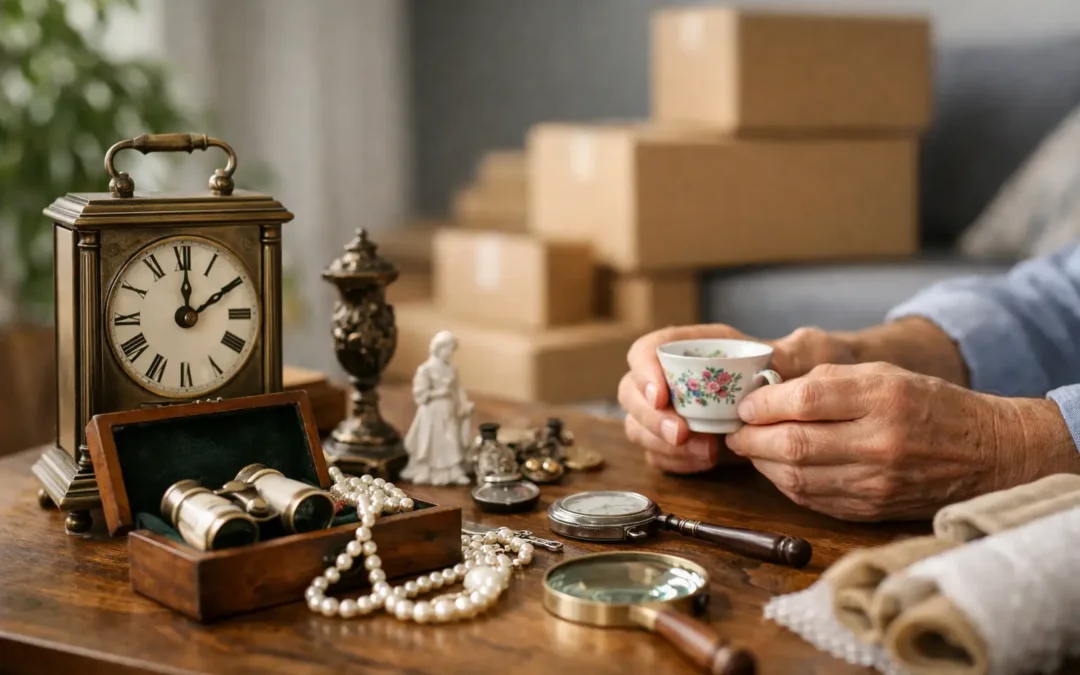
A house cleared in haste rarely produces the best result. When families are faced with downsizing and selling antiques, the pressure is often practical before it is commercial – a move has been agreed, an estate must be administered, or a lifetime of possessions suddenly needs to be assessed in weeks rather than years. That is precisely when clear judgement matters most.
Antiques and collectables do not respond well to blanket decisions. One room may contain pieces of modest decorative value, another may hold specialist material with a stronger auction market than the owner realises. The central task is not simply getting items out of the house. It is separating what should be retained, what may be sold, and what deserves proper expert attention before any decision is made.
Why downsizing and selling antiques needs a plan
The most common mistake is to treat the contents of a property as a single category. In practice, furniture, pictures, jewellery, silver, ceramics, clocks, books and works of art each follow different market patterns. Condition, provenance, fashion, rarity and estimate level all affect the likely route to sale.
A mahogany chest that has lived in the same house for fifty years may be handsome but currently meet a selective buying audience. A small piece of Chinese porcelain, a military medal group, or a painting by a recognised hand may attract much stronger competition. Sentimental attachment can obscure this distinction, but so can the opposite problem: assuming older automatically means valuable. It does not.
A structured review helps avoid both errors. Begin by identifying the categories present and treating them separately. This is less dramatic than emptying a house in one sweep, but it usually produces better decisions and a more defensible financial outcome.
Start with identification, not disposal
Before anything leaves the property, it is sensible to establish what is there. This does not require a museum-style inventory, but it does require discipline. Photograph groups of objects in situ, note sizes where useful, and record any signatures, labels, inscriptions or receipts kept with the item. If a family member knows the history of a particular piece, write it down. Provenance is often lost through assumption rather than neglect.
This stage matters because once pieces are dispersed, context disappears. A tea service with matching parts stored in different cupboards, a set of chairs split between rooms, or a painting with paperwork tucked in a drawer can easily be broken up. Reassembling those details later is awkward and sometimes impossible.
For executors and families dealing with inherited property, this initial pause is especially valuable. It creates a proper basis for valuation and helps prevent disagreement over what was present and what was sold.
What usually merits closer attention
Certain categories justify specialist review as a matter of course. Jewellery, watches, silver, coins, medals, fine paintings, Asian works of art, sculpture, early ceramics and quality clocks frequently perform best when correctly catalogued and placed before the right bidding audience. Books and maps can also be overlooked, particularly where there are complete collections, private press editions or interesting bindings.
Furniture is more dependent on style, size and condition than many sellers expect. Good early pieces, unusual vernacular examples and furniture with strong originality can still attract serious bidders, while bulky reproductions or heavily altered examples may not. Decorative appeal has a bearing, but market appetite remains selective.
Valuation is not the same as a guess
During downsizing and selling antiques, owners are often offered quick opinions from well-meaning friends, house clearance firms or dealers prepared to buy outright. There is nothing inherently wrong with an immediate purchase if speed is the priority, but sellers should be clear about the trade-off. Convenience can come at the expense of open market competition.
A formal auction valuation serves a different purpose. It considers the item in its correct category, assesses condition and salability, and places it against recent demand. Crucially, it also helps determine whether the object suits a specialist sale, a general auction, or another route altogether.
This is where expertise earns its keep. The difference between an object sold as a generic household piece and the same object properly catalogued can be considerable. Attribution, date, material, maker and provenance all shape buyer confidence. Serious bidders respond to accuracy.
Reserve, estimate and expectation
Sellers sometimes fix on a single number and treat anything below it as failure. Auctions are more nuanced than that. The estimate is a guide based on market evidence and buyer appetite at the time of sale. A reserve protects the seller to a degree, but if set unrealistically high, it can suppress bidding and leave the lot unsold.
A sensible estimate encourages participation. Once two or more bidders recognise value in the same lot, the market often speaks more clearly than private negotiation. Not every piece will exceed expectations, of course. Some categories are softer than they were twenty years ago, while others remain highly competitive. The point is to approach the sale with informed realism rather than inherited assumptions about worth.
Choosing the right sale route
Not every object belongs in the same auction. One of the practical advantages of a well-established auction house is breadth of category knowledge and the ability to place material where it stands the best chance of attracting the right buyers.
A specialist sale gives stronger context to finer works, unusual collectors’ pieces and objects requiring focused cataloguing. General sales can be entirely suitable for mid-market furniture, decorative ceramics, glass, prints and mixed private property. In some cases, grouping lower-value items into collections or room lots makes better commercial sense than offering them individually.
That judgement is particularly important when clearing a house for move or probate. Time matters, but indiscriminate disposal often destroys value. A balanced approach recognises that some items justify individual treatment, some work best in groups, and some may not be worth the cost of transport and sale.
Practical considerations before consignment
Condition should never be improved by enthusiastic cleaning. Patina, surface wear and original fittings can be part of an object’s appeal. Over-polished bronze, aggressively cleaned silver, stripped furniture or washed labels may reduce confidence and value. If an item appears dusty, leave it lightly untouched until advised otherwise.
Equally, do not carry out amateur repairs. A chipped ceramic figure with a visible fault is usually preferable to a poorly restored one. Buyers and specialists can assess honest condition. Concealed intervention tends to cause problems later.
Transport and handling also deserve care. Mirrors, pictures under old glass, clocks with loose components, and marble-topped furniture are especially vulnerable during a hurried move. If the object is potentially valuable, proper collection and intake procedures are worth arranging.
For clients in Surrey and the wider south east, firms such as John Nicholson’s deal regularly with private houses, estates and collection dispersals, which is often useful when a property contains mixed categories rather than one obvious area of value.
The emotional side of selling
Downsizing is not purely administrative. Even commercially minded sellers can hesitate when objects have formed part of family life for decades. That hesitation is understandable, and it is usually better to acknowledge it than pretend the process is purely transactional.
A measured approach helps. Decide first what must remain for personal reasons, then assess the balance on market terms. Trying to keep everything until the final week before a move usually leads to rushed choices. Equally, disposing of everything at once can create later regret, particularly where family members have not had the opportunity to identify pieces of genuine significance.
There is also a difference between sentimental importance and auction value. Sometimes they overlap, often they do not. Recognising that distinction early allows families to retain what matters personally while still making commercially sensible decisions elsewhere.
When timing matters most
There are occasions when speed is unavoidable. Exchange dates move quickly, executors face deadlines, and care-related transitions can compress the timetable. Even then, a short professional assessment is usually preferable to immediate clearance.
The reason is simple: once a potentially valuable item is sold too cheaply or discarded in error, the position cannot easily be recovered. A brief pause for identification and valuation can prevent a costly mistake. It can also provide reassurance where the contents turn out to be largely decorative rather than materially valuable.
That reassurance has its own worth. Good advice is not only about finding hidden treasures. It is also about giving owners a realistic, evidence-based view of what the market is likely to do.
The best results in downsizing and selling antiques rarely come from urgency alone. They come from sorting carefully, valuing properly and choosing a sale route that suits the object rather than the mood of the moment. If a house has taken decades to fill, it is worth giving its contents a little time to declare what they are.