
A painting may have hung in the same family home for decades, yet its value can turn on details that are not immediately visible: a faint signature, an old exhibition label, a repaired tear, or the difference between an original work and a later copy. Fine art valuations Surrey sellers seek should therefore be grounded in evidence, market knowledge and a clear understanding of the purpose of the valuation.
For an executor dealing with an estate, a homeowner considering a move, or a collector refining a collection, the question is rarely simply, “What is it worth?” The more useful question is, “What could it reasonably achieve in the appropriate market, at this point in time?” A sound valuation addresses both.
Fine art valuations in Surrey: what determines value
An auction valuation is an informed opinion based on the work itself and the market in which it may be offered. It is not a fixed price. Works of art are not interchangeable commodities, and two paintings by the same artist can produce markedly different results according to subject, date, scale, condition and provenance.
Attribution is the starting point. Is a picture signed, inscribed or dated? Does the signature correspond with known examples? Is it by the named artist, from their studio, after their work, or in the manner of a particular school? These distinctions are material. A confidently attributed oil painting by a recognised artist may command serious interest, while a later decorative copy may have a very different audience and value.
Subject matter also has a bearing. An artist may be best known and most collected for a particular subject – coastal scenes, sporting pictures, portraits or botanical studies, for example. A work that reflects the strongest part of an artist’s output will often attract greater competition than a less typical example. Size, medium and period matter too. A substantial, accomplished oil painting may sit in a different market from a small pencil study, though there are exceptions where a drawing is rare or historically significant.
Condition requires careful assessment. Craquelure, the fine network of age-related cracking seen in oil paint, is not necessarily a concern. By contrast, extensive overpainting, a lined canvas, paint loss, fading, staining or poor restoration may affect both desirability and estimate. Works on paper need particular care: foxing, light damage, mount burn and trimming can all reduce appeal. Condition is not always a reason not to sell, but it should be reflected honestly in the valuation and catalogue description.
Provenance – the ownership history of an object – can be equally influential. A picture accompanied by a family receipt, an exhibition catalogue, a gallery label or correspondence may be easier to attribute and more attractive to bidders. Provenance does not have to be glamorous to be useful. A clear, credible chain of ownership can support confidence in a work; gaps or uncertainties may temper it.
The difference between an auction estimate and other valuations
The phrase “valuation” is used broadly, but the purpose changes the figure and the method behind it. This is particularly relevant when several family members, solicitors or insurers are involved.
An auction estimate is a guide to the likely hammer price range in a competitive sale, before the buyer’s premium is added. It takes account of recent comparable sales, the expected bidder base and the level at which interest is likely to begin. A reserve, agreed separately with the seller, is the confidential minimum hammer price at which a lot may be sold.
An insurance valuation is different. It normally reflects replacement cost rather than what the work would make at auction. For a rare or difficult-to-replace object, that figure can be materially higher than an auction estimate. Using an auction estimate for insurance purposes may leave an owner underinsured; using an insurance figure as an expectation for sale can lead to disappointment.
Probate and inheritance-related valuations have their own requirements and should be prepared for the relevant date and purpose. In these cases, clear descriptions, stated assumptions and a disciplined approach to evidence are essential. A general verbal indication may be helpful at an early stage, but it is not a substitute for a formal written valuation where legal, tax or insurance decisions depend upon it.
What a specialist will examine
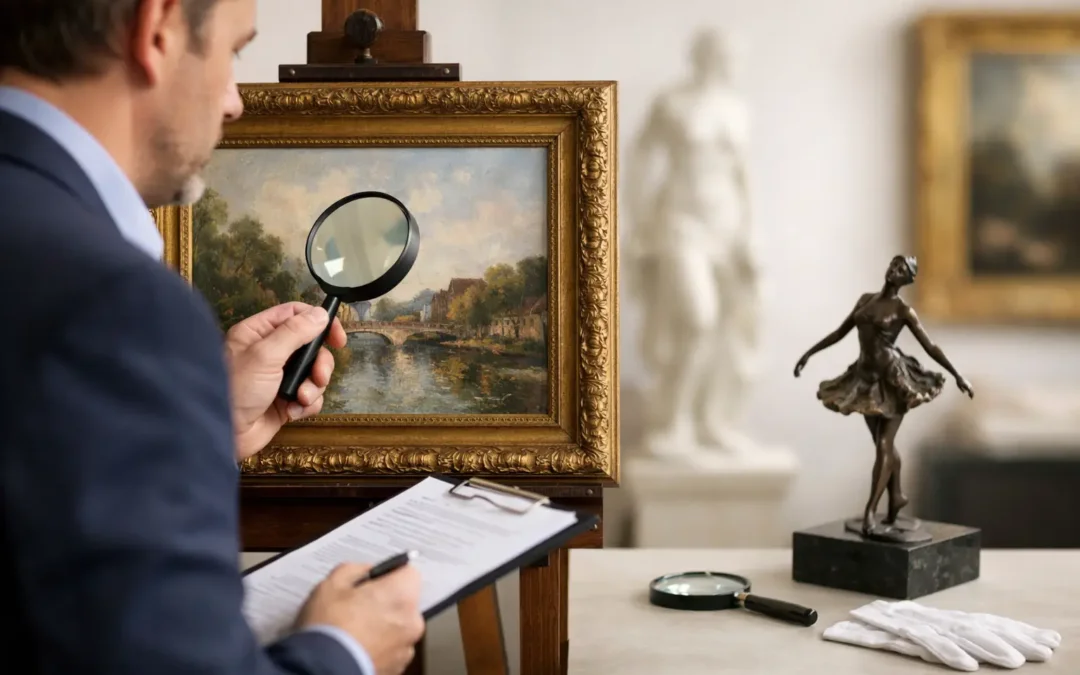
A proper assessment begins with direct inspection whenever practical. Good photographs are useful for an initial view, particularly when arranging a home visit or deciding whether an item merits closer examination, but they can conceal scale, surface condition and details on the reverse.
The front and back of a painting often tell different parts of the story. On the reverse, a specialist may find labels from exhibitions, framers or dealers, old collection marks, stamps, inscriptions and evidence of earlier restoration. The frame itself can also be relevant. It may be a later decorative frame with modest commercial value, or an original period frame that contributes to the work’s presentation and appeal.
For prints and works on paper, the assessment may include the technique, edition, paper, margins, signature and numbering. A signed, limited-edition print is not automatically valuable, nor is an unsigned impression automatically without merit. The artist, image, edition size, condition and demand all need to be weighed together.
Sculpture brings further questions: material, foundry mark, edition number, patina, dimensions and whether a cast is authorised. With contemporary art, exhibition history, gallery documentation and authenticity certificates may be particularly useful. No single document guarantees value, but the fuller the supporting material, the more confidently a work can be represented to buyers.
Preparing a work for valuation
Owners can make the process more efficient by gathering what they already have, without attempting restoration or research that might cause harm. If available, keep together purchase invoices, old valuations, exhibition catalogues, certificates, correspondence and photographs showing the work in an earlier setting. Record any known family history, including where and when it was acquired.
Take clear photographs in natural, indirect light. Include the whole work, close-ups of signatures or inscriptions, the back, labels and any apparent damage. Avoid flash where possible, as it can obscure the paint surface. Dimensions should be taken from the image or object itself rather than from the overall frame, unless both are stated.
There are a few actions best avoided. Do not clean a painting with household products, remove labels, retouch damaged areas or discard an old frame before advice has been obtained. A well-intentioned attempt to improve appearance can reduce value or make authentication more difficult.
From valuation to sale
A valuation is most useful when it leads to a considered selling strategy. For a work with broad appeal, an established specialist auction can offer exposure to collectors, dealers and international bidders. Competition is the central advantage of auction: where more than one bidder wants the same lot, the final price can exceed an initial expectation.
That does not mean auction is the right route for every item. A very low-value decorative picture may not justify the costs of specialist cataloguing and photography. Conversely, a work requiring further research, conservation advice or consultation with an artist’s estate may benefit from more preparation before it is placed in a sale. Timing can matter as well. A collection of sporting art, Asian works or regional landscape painting may perform best when included in a sale that reaches the right informed audience.
At John Nicholson’s, valuations are considered in the context of the appropriate sale category, catalogue presentation and likely bidder demand, rather than as isolated figures. This matters for mixed estates, where fine paintings may sit alongside jewellery, furniture, ceramics, books or collectables. Each category can require a different marketing approach, estimate level and sale timetable.
Sellers should also be realistic about the relationship between estimate and result. A strong result is possible, but it is not guaranteed. The market responds to quality, rarity and competition, as well as factors no valuer can control fully, such as the number of active buyers on the day. A carefully judged estimate is intended to encourage participation, not to understate the work’s worth.
The best time to seek an opinion is before a house clearance, a move or a division of assets makes decisions harder. A measured valuation gives owners the evidence to decide whether a picture belongs in the saleroom, should be retained, insured or researched further – and that clarity is often as valuable as the figure itself.