
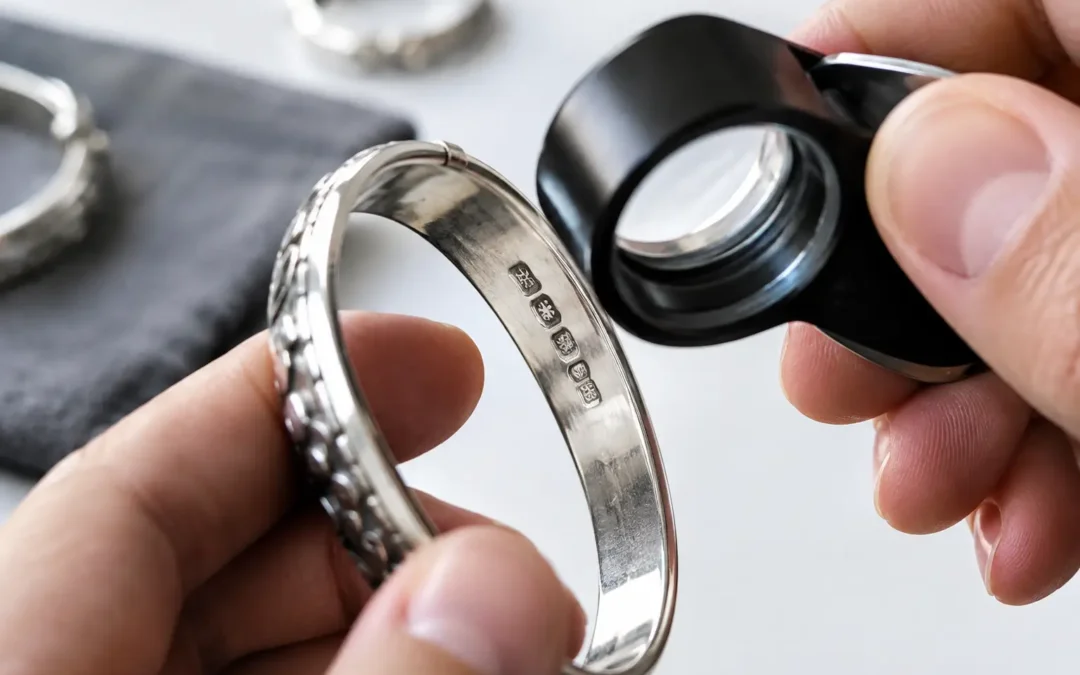
A tray described as ‘sterling silver’ can look entirely convincing until the marks are read closely. A misplaced assay-office symbol, an implausible date letter or a freshly cut maker’s mark may materially alter both the description and the value. Knowing how to authenticate silver hallmarks is therefore useful whether you are assessing an inherited tea service, considering a purchase, or preparing silver for sale.
The hallmark is evidence, not a guarantee in isolation. It must agree with the object’s construction, style, weight, condition and provenance. In auction practice, those details are considered together before a piece is catalogued as silver, silver plate or an item of uncertain metal.
How to authenticate silver hallmarks: start with the object
Before examining individual punches, look at the article as a whole. English silver hallmarks are normally struck in an unobtrusive but accessible position: beneath a salver, on the underside of a spoon handle, inside a cup foot, or around the rim of a jug. On hollow ware, marks may be partly obscured by wear, repairs or later engraving, but their placement should still make practical sense.
Use a jeweller’s loupe of at least 10x magnification and examine the marks under good, raking light. Do not polish the area before inspection. Aggressive cleaning can soften already faint marks and remove the dark residue that makes them legible. Photograph the marks, the whole object and any areas of damage or repair before seeking an opinion.
The metal should also support the claim. Sterling silver has a particular colour and reflectivity, but visual judgement alone is unreliable. Look instead for worn areas on raised decoration, handles, rims and feet. If a yellowish base metal, coppery tone or peeling surface is visible, the article is likely plated rather than solid silver. This does not make it valueless, but it changes the description and market category.
Read the British hallmark in its proper sequence
For most modern British silver articles above the legal exemption weight, the compulsory marks identify the sponsor, the standard of fineness and the assay office. Older pieces often carry additional symbols that allow dating and provide valuable confirmation.
Sponsor’s mark
The sponsor’s mark, often called the maker’s mark, identifies the registered person or business responsible for submitting the article for hallmarking. It is usually initials within a shaped surround. This mark is not necessarily the name of the silversmith who physically made the piece: a retailer, importer or manufacturing firm may have registered it.
A familiar set of initials is not enough. The exact letter forms, punctuation and surrounding cartouche matter. Several makers may share the same initials, while a single firm may use different marks over time. The mark must be plausible for the stated place, period and type of object.
Standard mark
The standard mark confirms silver fineness. Sterling silver is commonly marked with a lion passant on British pieces, or with the numerical standard 925. Other recognised British standards include Britannia silver, traditionally shown by the figure of Britannia and now often accompanied by 958, and lower standards such as 800 or 835 in certain contexts.
Do not assume that every ‘925’ mark proves British sterling. Numerical marks are used internationally and may appear on modern imported goods. Their meaning depends on the other marks present and the article itself.
Assay-office mark
The assay-office mark identifies where the piece was tested and hallmarked. The four historic British assay offices are represented by well-known symbols: the leopard’s head for London, the anchor for Birmingham, the crown for Sheffield on older work, and the castle for Edinburgh. Their appearance has changed over time, so a symbol must be read against the correct period.
Some marks are easily misread when worn. A leopard’s head, for example, is not always accompanied by a crown, and assumptions based on simplified reference images can lead to incorrect dating. Clear photographs at several angles are often preferable to a hurried reading under poor light.
Date letter and duty mark
On much antique British silver, a date letter is one of the most useful tools for authentication. Each assay office used its own annual alphabet, changing the letter style, case and shield shape from cycle to cycle. A lower-case letter in one cartouche may date very differently from the same letter in another.
Date letters have not been compulsory since 1999, so their absence on recent British silver is not suspicious by itself. Likewise, the sovereign’s duty mark, used from 1784 to 1890, may help date Georgian and Victorian pieces but will not appear on later articles. These marks should be treated as supporting evidence rather than expected on every item.
Match the marks to the style and construction
A correct-looking hallmark can still be wrong for the object. A tea caddy in a late Victorian revival style with marks supposedly from the 1730s deserves close attention. So does a heavily cast, machine-finished candlestick presented as early hand-raised silver. Hallmarks date the assay of the article, not necessarily the entire history of every component.
Repairs are especially relevant. A later handle, foot, finial or replacement section may carry its own marks, or none at all. On pairs, compare the marks carefully. Genuine pairs often show small variations in strike and position, but the underlying marks should be compatible in date, office, standard and sponsor.
A newly applied armorial, inscription or presentation plaque also needs separate assessment. It may be later than the vessel and can enhance, reduce or complicate value depending on quality, provenance and condition.
Know the difference between silver and plated ware
Many attractive domestic objects are silver-plated rather than sterling silver. Common marks include EPNS for electroplated nickel silver, A1, EP or the name of a plating firm. These are not assay hallmarks and should not be represented as solid silver.
Terms such as ‘silver on copper’, ‘silver mounted’, ‘filled’ and ‘weighted’ require care. A weighted candlestick, for example, may have a silver outer shell over a cement or resin-filled base. Its hallmarks can be genuine, but the article’s melt value is very different from that of a solid silver candlestick. Handles on knives are frequently silver-mounted over steel blades and may be filled.
Foreign silver brings a further layer of complexity. French, Dutch, German, Scandinavian, Indian and American systems use different national marks, town marks, control marks and fineness conventions. Pseudo-hallmarks – decorative marks made to resemble British punches – are also found on imported and later decorative wares. A British-style lion, anchor or date letter without a coherent group of accompanying marks should not be accepted at face value.
Warning signs that merit specialist scrutiny
A hallmark should appear struck into the metal, with consistent depth and a degree of natural wear appropriate to the object. Alarm bells ring when a mark is unusually sharp on an otherwise worn article, sits on a visibly inserted patch, interrupts a seam, or appears in an illogical location. Differences in surface colour around the mark may suggest soldering, replacement or an added section.
Be wary too of hallmarks that have been copied from a known maker but combined with the wrong date letter or assay-office symbol. This is a common weakness in spurious marks: each element may look credible separately, yet the combination never existed. Modern laser marks can also look too even and superficial when compared with traditional struck punches.
Testing methods have limits. A magnet will identify some base-metal components but cannot authenticate silver, which is non-magnetic. Acid testing can damage a surface and may only establish the composition of a tiny tested area. X-ray fluorescence testing is non-destructive and useful, but it reads the surface rather than every hidden component. It is best used alongside a close hallmark examination and an assessment of construction.
When provenance and a valuation matter
For a modest spoon, clear marks and a sensible visual assessment may be enough. For a matched service, important provincial piece, early silver, jewellery or an object carrying a prestigious maker’s mark, independent expertise is worthwhile. Value may rest not merely on silver weight but on maker, rarity, design, condition, engraving and collector demand.
Keep old receipts, family notes, presentation cases and photographs with the object. Provenance does not replace hallmarks, but it can explain an unusual inscription, establish a family connection or strengthen confidence when a piece is offered for sale. Equally, do not discard apparently mismatched components before they have been assessed: a period replacement can be part of an object’s history.
At John Nicholson’s, silver is assessed as an auction object rather than simply as metal. Clear images of the full article, its hallmarks, measurements and any damage allow a preliminary view, while an in-person valuation remains the soundest route for significant pieces.
If the marks and the object do not tell the same story, pause before buying, polishing or consigning. A careful examination can prevent an expensive mistake, and may reveal that an unassuming family piece has more than scrap value.