
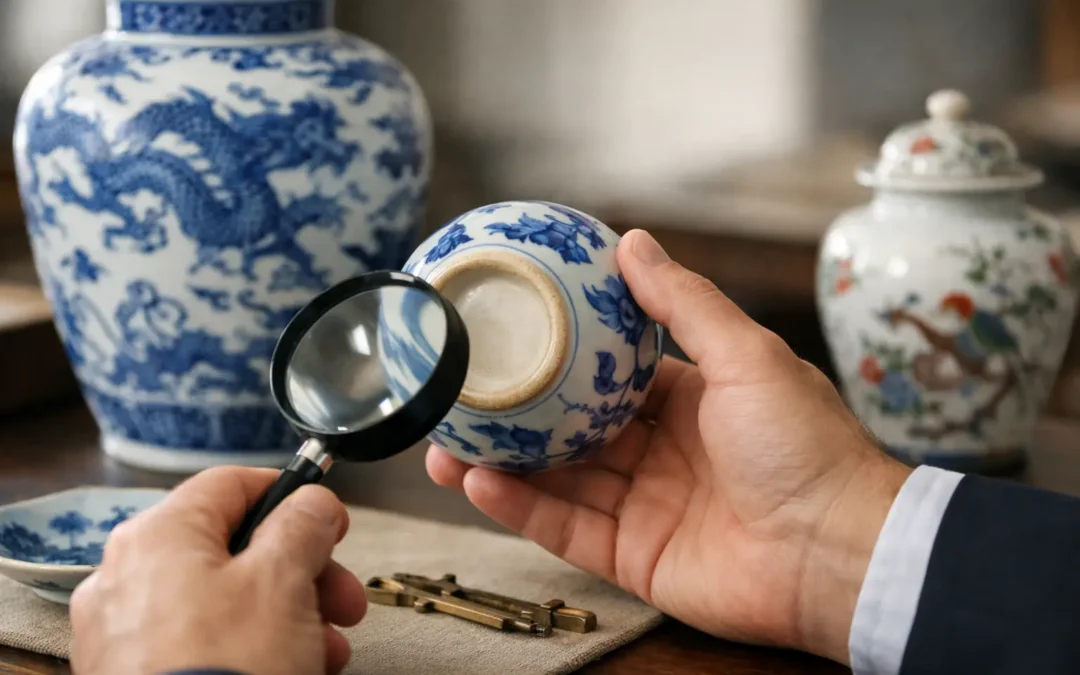
A blue-and-white vase found in a family cabinet may be Chinese, but that alone says very little about its date, origin or value. Chinese porcelain has been made for centuries, copied internationally and reproduced in enormous quantities. Learning how to identify Chinese porcelain means assessing the whole object – not relying on a reign mark, a single motif or an appealing story of inheritance.
At auction, the most convincing pieces tend to reveal their quality gradually: in the weight and finish of the body, the depth of the glaze, the confidence of the painted decoration and the relationship between all these elements. A careful examination can help an owner decide whether an object merits specialist attention, while avoiding costly assumptions.
How to identify Chinese porcelain by looking at the whole piece
Begin with shape, material, glaze, decoration and condition. These features are more reliable when considered together than in isolation. A mark on the base can support an attribution, but it should rarely lead it.
Chinese ceramic production encompasses Song celadons, Ming blue-and-white, famille verte and famille rose enamels of the Qing dynasty, export wares made for European markets, provincial wares and 20th-century decorative porcelain. The category is far too broad for a single visual rule. A finely potted 18th-century bowl and a 19th-century famille rose vase may have very different characteristics, despite both being described as Chinese porcelain.
Examine the body and potting
Hold the piece carefully, preferably in natural light. True porcelain is generally hard, dense and finely finished, with a vitrified body created by firing at high temperatures. Where the body is exposed at the foot rim, it may appear white, cream, greyish or slightly buff depending on the period and kiln.
Older Chinese pieces are often lighter and more finely potted than later decorative copies, though weight is not a decisive test. Look for a considered profile: a balanced foot, a neatly formed rim and proportionate handles or spouts where present. Coarse mould lines, thick walls and an awkwardly finished base may indicate later manufacture, but some export and provincial wares were made more simply and remain collectable in their own right.
Do not perform a so-called light test as proof of age or authenticity. Thin porcelain can transmit light, but so can much later porcelain. Nor should an object be tapped aggressively. The resulting sound is affected by size, shape, restoration and existing cracks.
Read the glaze, not just the colour
A good glaze has depth. On Chinese porcelain it may be glassy, soft, slightly uneven or subtly pooled around carved or moulded detail. Early glazes can show natural firing variation, tiny kiln grit or an orange-peel texture. These are not automatically faults.
Examine the underside, interior and areas around the foot. A truly old object usually shows coherent wear consistent with its use and age. This might include gentle rubbing to a foot rim, minor glaze wear to a rim or light scratching beneath. Artificial ageing, by contrast, often looks contrived: dark staining forced into cracks, uniformly abraded edges or dirt sitting where ordinary handling would not place it.
Crackle glaze deserves particular care. Genuine crazing is a network of fine glaze lines caused by the relationship between glaze and body. It occurs on wares from several periods, but it is also easy to imitate. Darkened crackle alone is not evidence of antiquity.
Decoration can indicate period and purpose
The decoration on Chinese porcelain is often the most immediate clue, but motifs should be read with discipline. Dragons, lotus flowers, peonies, bats, precious objects and landscapes all have long histories. Their mere presence does not date a piece.
Blue-and-white decoration was painted in cobalt beneath a clear glaze. On better examples, the blue may show tonal variation, from a soft wash to a deep, inky concentration. The brushwork should have energy and purpose, even where it is informal. Later copies can reproduce the subject well while lacking the fluent line, spacing and painterly assurance of earlier work.
Overglaze enamels offer other clues. Famille verte wares commonly use greens with iron red, yellow, blue and black outlines, while famille rose decoration is associated with softer pinks and an expanded enamel palette. Such terms describe palette and technique, not a guaranteed date. Both styles were revived and copied extensively.
Pay attention to how decoration fits the shape. On a strong piece, panels, borders and central motifs tend to work with the form rather than being applied mechanically. Decorative density is also relevant. Some 19th-century pieces are richly painted with a crowded surface, whereas earlier wares can appear more restrained. Yet there are exceptions in every period, particularly in imperial and export production.
Consider export porcelain separately
Porcelain made for export is often misunderstood. Chinese potters produced dinner services, armorial wares, punch bowls and decorative objects specifically for European buyers, particularly during the 18th century. These can carry Western coats of arms, European scenes or unusual shapes, while still being unquestionably Chinese in manufacture.
A Western-looking design is therefore not proof that a piece was made in Britain or continental Europe. Equally, a Chinese-inspired pattern on English porcelain is not proof of Chinese origin. The body, foot, glaze and painted manner remain central to the assessment.
Chinese porcelain marks require caution
Reign marks are among the most misread features of Chinese porcelain. A six-character mark may name an emperor and dynasty, often in regular script or seal script, but it can be apocryphal. Later makers regularly used earlier reign marks as a mark of respect, a stylistic reference or, on occasion, a commercial device.
For this reason, a Kangxi mark does not automatically mean Kangxi period, and a Qianlong mark does not automatically date a vase to the 18th century. The mark must correspond with the form, paste, glaze and decoration. Its placement and calligraphy matter too. A mark that looks excessively neat, heavily printed or out of character with the rest of the piece should prompt further scrutiny.
Some genuine Chinese porcelains are unmarked. Others have shop marks, symbols, artemisia-leaf marks, collector’s labels or later inventory numbers. These can be useful supporting evidence, especially when accompanied by a known collection history, but they do not replace object-based expertise.
Age, damage and restoration affect value
An old object is not necessarily valuable, and a later object is not necessarily without interest. Market value depends on rarity, quality, condition, provenance, period, size and current collector demand. A modest but honest 18th-century export plate can be appealing, while a heavily restored imperial-style vase may be difficult to sell.
Inspect the rim, handles, neck and foot for chips, hairline cracks and sections that sound or look different from the surrounding porcelain. Restoration may be visible as a change in gloss, colour or fluorescence under ultraviolet light, although UV examination requires experience to interpret properly. Repainted decoration, filled chips and rebuilt sections can significantly alter an auction estimate.
Do not clean aggressively before seeking advice. Abrasive products can remove gilt decoration and glaze surface, while household bleaching or soaking may worsen old repairs. Keep associated stands, boxes, receipts, labels and family records. Provenance can strengthen confidence in an attribution and, in some cases, materially improve marketability.
When to seek a specialist valuation
A specialist should examine any piece that appears finely painted, unusually thinly potted, marked, associated with a known collection or inherited with credible history. This is particularly true of blue-and-white jars, decorated vases, brush pots, bowls, wine cups and figures, as these forms are frequently copied and can vary considerably in quality.
Clear photographs are useful for an initial opinion: include the front and reverse, the base, close details of decoration and any marks, plus all damage. Measurements and a brief account of where the piece came from will help. However, a definitive assessment may require viewing the object in person. Weight, glaze texture, firing marks and restoration are not always apparent in images.
At John Nicholson’s, Chinese and Asian art is assessed with auction context in mind: not merely whether an object is old, but how confidently it can be catalogued, who is likely to buy it and where it sits in the current market. That distinction matters when deciding whether to retain, insure or sell a piece.
The most sensible approach is measured curiosity. Handle the porcelain carefully, record what you can see, preserve its history and allow the object itself – rather than an ambitious mark or family legend – to determine the next step.