
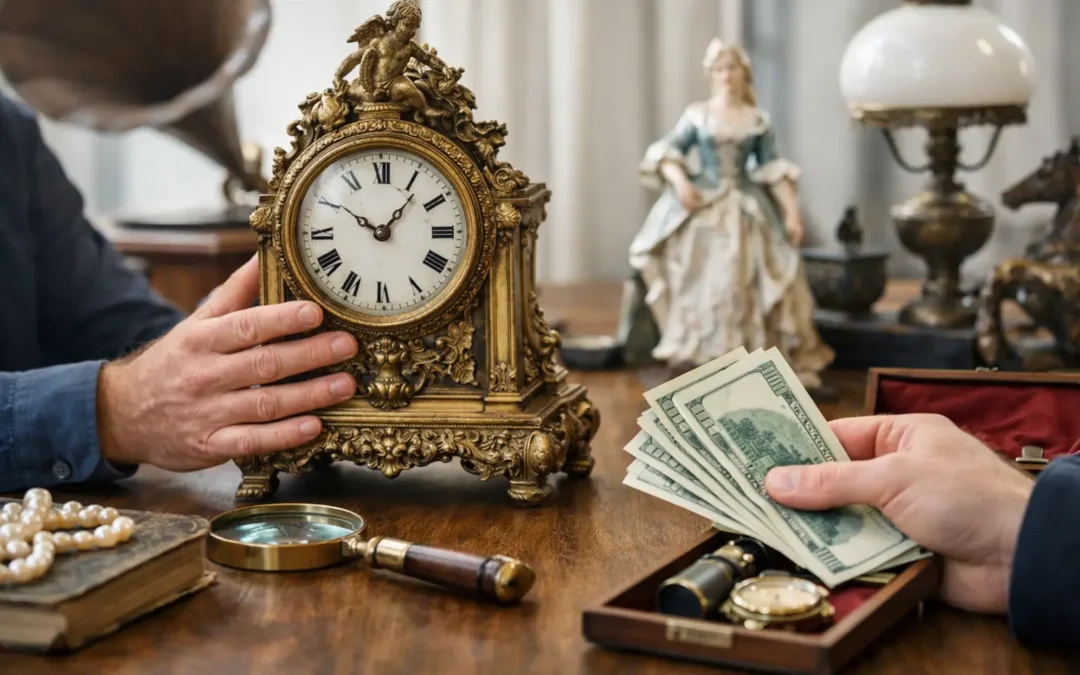
A house clearance can move quickly after a bereavement, particularly when a property must be sold or emptied. Yet deciding how to sell inherited antiques deserves more care than simply accepting the first offer, or sending everything to a general dealer. A seemingly ordinary picture, clock, cabinet or piece of silver may have a specialist market, while other objects are better sold locally, grouped into a general auction or retained by the family.
The sensible starting point is not to ask, “What is it worth?” but “What exactly do we have, and who is likely to buy it?” That distinction determines whether an object should be offered in a specialist sale, a general antiques auction, a timed online auction, or not sent to auction at all.
How to sell inherited antiques: begin with an inventory
Before distributing items among relatives, arranging collection or clearing a room, make a simple inventory. Photograph each object in good natural light, including signatures, maker’s marks, labels, hallmarks, inscriptions, serial numbers and any damage. Record dimensions and, where known, the history of ownership.
This is not needless administration. A painted label on the reverse of a picture, a retailer’s stamp on a clock movement or a family note identifying a previous owner can materially affect attribution and buyer confidence. Provenance does not have to be grand to be useful. Evidence that an item has remained in one family since the early twentieth century may help an auctioneer build a more credible catalogue description.
Keep relevant paperwork together: old invoices, valuation documents, exhibition catalogues, certificates, correspondence and photographs showing an item in its original setting. Do not assume that a faded receipt is irrelevant. Equally, do not rely on family tradition as fact. An auction specialist can present a tradition appropriately, but should not turn an unverified story into a definitive attribution.
Do not clean, restore or divide too soon
One of the most expensive errors is trying to improve an antique before it has been assessed. Polishing silver aggressively can remove desirable surface detail. Over-cleaning a painting may disturb its original finish. Replacing a clock dial, handles on furniture, or a worn jewellery fitting can reduce originality and affect value.
Dust and surface dirt are one matter; restoration is another. If an object needs attention, ask a specialist first whether conservation is justified and, if so, what level of work is appropriate for its likely market. The cost of restoration should be proportionate to the anticipated sale price. It is rarely commercially sensible to spend heavily on a modest object merely to make it appear newer.
The same caution applies to sets and collections. A group of books, medals, ceramics or documents may be worth more intact than as individual pieces. Conversely, a large collection may perform better when divided into carefully chosen lots. That judgement depends on rarity, condition, subject matter and the habits of likely buyers.
Obtain the right kind of valuation
A valuation for probate, insurance and auction sale are not interchangeable. Probate valuations are generally prepared to establish an open-market figure at a particular date. Insurance valuations commonly reflect replacement cost, which is often higher. An auction estimate is a practical prediction of what an item may achieve in a competitive sale, based on condition, current demand and comparable results.
For inherited antiques, request advice from an auction house or valuer with relevant category knowledge. A general impression of value is not enough for a Chinese porcelain vase, a signed painting, a diamond ring, a longcase clock or a collection of coins. These markets have different buyers, terminology and factors affecting condition.
A proper appraisal also identifies what should not be consigned. Some items have sentimental significance but limited resale demand; others may be too damaged, too common or too costly to transport. Straightforward advice at this stage prevents wasted time and unrealistic expectations.
If you are acting as an executor, keep a clear record of valuations, instructions, reserve prices and sale proceeds. Where several beneficiaries are involved, transparency is as valuable as a strong hammer price. Agree the route to sale before consigning, especially if family members may later wish to retain particular pieces.
Choose a sale route to suit the object
Auction is often the strongest route for objects with scarcity, quality, maker interest or collector appeal because it exposes them to competing bidders. A specialist sale can place a work before buyers actively seeking that category, while live and online bidding broadens the audience beyond the immediate area.
That does not mean every inherited item belongs in a high-profile specialist auction. General household antiques, decorative furniture and lower-value collectables may be better suited to a general sale, where estimates and cataloguing costs are proportionate. Some bulky furniture has a narrower market than families expect, particularly if it is difficult to place in a modern home. Fine quality, condition and design still matter, but size and practicality influence demand.
Private treaty sale may suit an exceptional work where discretion is required or a known buyer is likely. A dealer sale can provide speed and certainty, but normally at a lower price because the dealer must allow for risk, overheads and eventual resale. House clearance is useful for residual contents, but should generally follow – not replace – specialist assessment of potentially valuable objects.
At John Nicholson’s, specialists consider both the object and its likely market when advising on consignment. The aim is not simply to put a lot into the next available sale, but to select a category, estimate and timing that give it a credible chance of attracting serious bidding.
Understand estimates, reserves and charges
An estimate is a guide, not a guarantee. It helps buyers decide whether to bid and gives the market a starting point, but strong interest can take a lot beyond the upper estimate. Equally, an ambitious estimate can deter early bidding and leave an item unsold.
A reserve price is the confidential minimum at which you are prepared to sell. It should be realistic and agreed with the auctioneer. A reserve set too close to, or above, the upper estimate may prevent a sale, even where there is genuine interest. In some cases, no reserve is advisable, particularly for modest lots where competitive bidding is more likely to develop from an attractive opening level.
Ask for the seller’s terms in writing. They should explain commission, any illustration or catalogue charges, insurance, transport, restoration costs where applicable, and what happens if a lot does not sell. The relevant question is the likely net return, not merely the headline hammer price.
Present the objects honestly
Condition is central to antique value. Tell the valuer about repairs, alterations, losses, cracks, replaced parts and previous restoration, even if you believe they are minor. Specialist examination may reveal issues that are not obvious, but information from the family can be equally useful.
Do not conceal damage in photographs or remove labels because they look untidy. Buyers value clear, accurate cataloguing and will bid with greater confidence where condition is properly described. A disappointing discovery after the sale can lead to a dispute, delay payment or damage the credibility of the consignment.
It is also worth checking ownership before sale. An inherited object may have been specifically gifted in a will, promised to a family member, held jointly, or subject to an executor’s duties. Where there is uncertainty, resolve it before the item leaves the property.
Give timing a commercial purpose
There is no universal best month for selling antiques. Timing depends on the category, the auction calendar and whether the object needs research, condition reporting or professional photography. A rushed consignment can miss the sale best suited to it; waiting indefinitely can be equally unhelpful when an estate needs to be administered.
Allow enough time for specialist cataloguing and marketing, particularly for art, jewellery, Asian works, books, coins and objects with notable provenance. Good cataloguing does more than describe an item. It gives informed buyers the details they need to recognise quality and compete with confidence.
Inherited antiques are often both assets and family history. Treat them accordingly: preserve the evidence, seek a category-appropriate valuation, and choose a sale method that reflects the object rather than the urgency of clearing a room. That measured approach gives each piece its fairest opportunity in the market.