
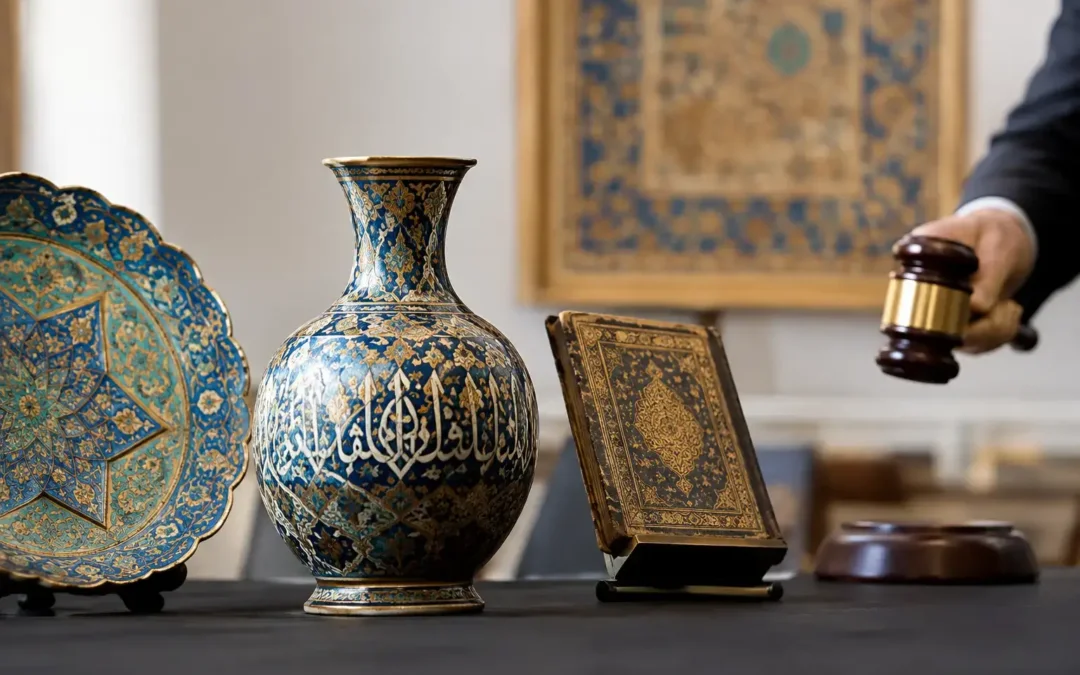
An Islamic art auction can bring together objects made across more than a millennium, from Spain and North Africa to the Ottoman Empire, Persia, Central Asia and the Indian subcontinent. That breadth is part of the category’s appeal, but it also explains why values can vary sharply between two apparently similar pieces. A small manuscript leaf, a bronze incense burner or a glazed pottery tile may carry significance far beyond its size, provided its date, origin, condition and provenance support the attribution.
For sellers, the aim is to place an object before the right specialist audience with a defensible estimate and proper catalogue treatment. For buyers, success lies in looking beyond decorative impact and understanding precisely what is being offered. Auction results are not determined by age alone. Rarity, quality, survival, collecting fashion and confidence in the cataloguing all matter.
What falls within Islamic art?
Islamic art is a broad art-historical term, rather than a description of one style, country or religious purpose. It commonly encompasses works produced in regions where Islamic cultures flourished, including ceramics, metalwork, manuscripts, calligraphy, textiles, arms and armour, woodwork, jewellery, glass, paintings and architectural fragments. Many objects were made for secular courts, domestic interiors or trade, as well as for religious settings.
This diversity requires careful language. A 19th-century Qajar lacquer pen box, for example, should not be assessed by the same criteria as a 12th-century Kashan lustre bowl. Both may be highly collectable, but their markets, materials, condition concerns and comparable results are different. Similarly, an object described as Ottoman may have been made in Istanbul, a provincial workshop or for export. The distinction can affect both scholarship and value.
Good cataloguing identifies the object type, probable place of production, period, material and decoration, while acknowledging uncertainty where it exists. Terms such as “attributed to”, “possibly” and “in the manner of” have specific significance in an auction catalogue. They are not incidental qualifications: they indicate the level of certainty on which a bidder should base a decision.
The factors that shape an Islamic art auction estimate
An estimate is a market judgement, not a guarantee. It reflects what the auctioneer believes a lot may reasonably achieve under competitive bidding, taking account of recent comparable sales and the object’s individual merits. In Islamic art, four questions usually carry particular weight: what it is, when and where it was made, how well it has survived, and whether its history of ownership can be traced.
Attribution and period
The strongest prices tend to be achieved by objects with a convincing attribution to a recognised period, region or workshop. A signed or dated piece may provide welcome certainty, although inscriptions must be read accurately and assessed in context. Signatures, royal marks and collector’s labels can add interest, but they require specialist scrutiny. Later additions and misleading marks are encountered across the art market.
Quality remains critical. Fine drawing in a manuscript illumination, crisp casting on a bronze vessel, richly controlled glaze on a ceramic or exceptional calligraphy can distinguish a superior example from a routine one. The best objects demonstrate both technical command and a coherent visual character.
Condition and restoration
Condition is often the point at which expectation meets reality. Islamic works of art frequently survive with wear consistent with their age and original use: rubbing to gilding, small chips to ceramic rims, old textile repairs, oxidisation to metalwork or light creasing to manuscript pages. Such issues do not automatically prevent a sale, particularly where rarity is high.
However, restoration can materially affect value. Repainting, extensive over-glazing, rebuilt sections, later retouching to miniatures and concealed breaks may alter how collectors judge a lot. A condition report is therefore essential, especially for buyers unable to inspect in person. It should be read alongside the photographs, not as a substitute for them. Asking clear questions before bidding is prudent where a feature may influence value.
For sellers, well-intentioned cleaning or repair can be a costly mistake. Do not polish metalwork, remove old mounts, wash textiles or attempt to improve a manuscript before specialist advice has been obtained. An original surface, even one showing age, is often preferable to an aggressively altered one.
Provenance and collecting history
Provenance is the record of an object’s ownership, collection and movement through the market. It can support authenticity, add scholarly interest and provide reassurance on lawful ownership and export history. Old invoices, catalogue entries, labels, family papers, photographs and correspondence may all be useful, even where they seem incomplete.
The level of documentation required depends on the object, its date, origin and market history. For material that may have left its country of origin relatively recently, buyers and auctioneers will expect greater clarity. Reputable sale handling includes appropriate due diligence, and lots may be withdrawn where questions cannot be satisfactorily resolved. This protects consignors, buyers and the long-term integrity of the market.
A prestigious previous collection can enhance desirability, but only where the link is properly evidenced. A handwritten label is a starting point for research, not proof in itself.
Preparing property for sale
A specialist valuation should begin with the object itself, rather than assumptions based on family history or online asking prices. Clear photographs of the front, reverse, base, inscriptions, damage and any labels are helpful for an initial assessment. If a work merits further consideration, physical examination allows the specialist to assess construction, materials, age, condition and evidence of alteration.
Bring together the paperwork you have, but do not worry if it is modest. A receipt from a London dealer, an old insurance schedule or a note identifying an inherited collection may help establish a useful trail. Equally, the absence of papers does not mean an object lacks value. Many legitimate works have passed through families for generations without detailed records.
The choice of sale matters. A dedicated specialist auction gives an Islamic work of art a clearer context than a broad household sale, allowing it to be marketed to collectors who follow the category. Catalogue photography, accurate measurements, detailed descriptions and an appropriately considered estimate all help create confidence before the lot reaches the saleroom.
At John Nicholson’s, valuations and sale recommendations are considered with both the object and the likely bidding audience in mind. This is particularly important for collections that include a mixture of Islamic, Indian, Chinese and European works, where correct categorisation can affect exposure and result.
Bidding with judgement at an Islamic art auction
The catalogue is the starting point, not the whole investigation. Before bidding, study every available image, read the description closely and request a condition report where one is not already provided. Check dimensions carefully. A photograph can make a small manuscript folio appear substantial, or make a large tile panel seem more manageable than it is.
It is also sensible to establish a maximum figure before the auction. Factor in the buyer’s premium, any applicable taxes, packing, shipping and insurance. For overseas bidders, import rules and associated charges should be considered before placing a bid, particularly for materials subject to regulation.
Online bidding has widened access to specialist auctions, allowing collectors to participate from well beyond the saleroom. It does not remove the need for discipline. A live online bid is binding, and a rapid sequence of competing bids can encourage decisions based on momentum rather than judgement. Where the lot is important to your collection, inspect it if possible or appoint a trusted representative to do so.
It depends, too, on your purpose as a buyer. An interior-led purchaser may reasonably prioritise colour, scale and decorative presence. A collector building a focused group of works may place greater emphasis on date, inscription, provenance and comparative rarity. Neither approach is wrong, but each calls for a different bidding limit.
Why specialist knowledge remains decisive
The Islamic art market rewards close looking. Objects that appear modest can prove rare through a distinctive inscription, an early glaze, an unusual form or an established collecting history. Conversely, an attractive object with extensive restoration or uncertain origin may require a more cautious valuation.
That is why careful appraisal, transparent cataloguing and proper pre-sale enquiry remain central to a well-run Islamic art auction. Whether you are considering the sale of a single inherited object or bidding on a long-sought work, the soundest next step is to examine the evidence closely and let the object’s real qualities determine the decision.
