
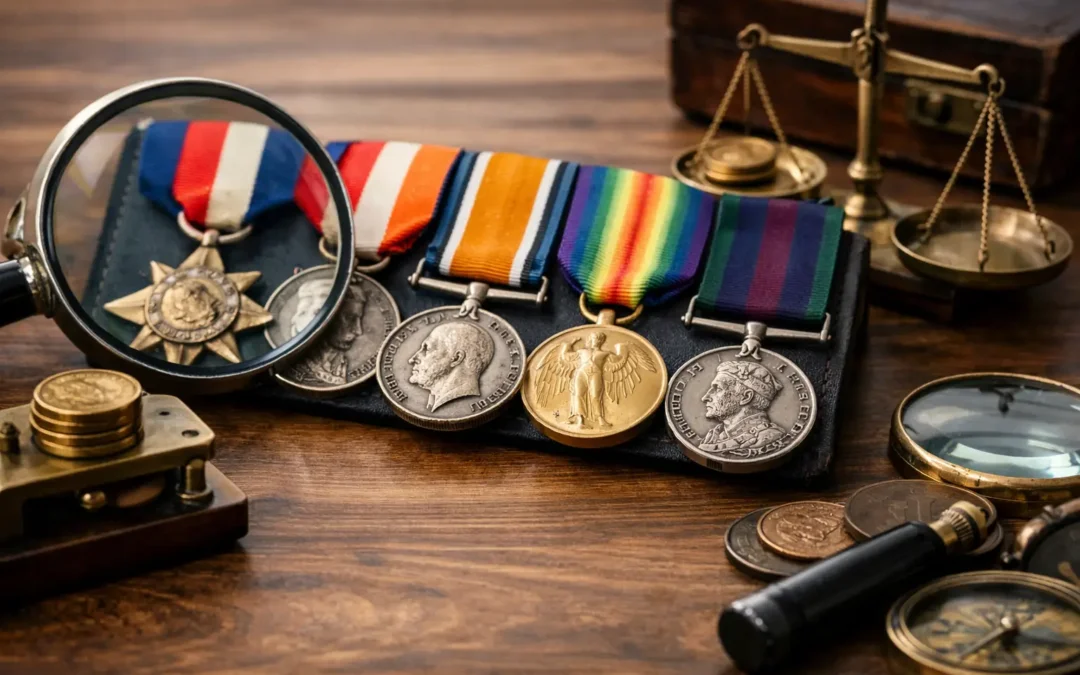
A group of medals may look modest in a drawer, yet its value can turn on one small detail: an officially named edge, an uncommon clasp, a casualty record, or a family archive that identifies the recipient. For those seeking a military medals valuation UK service, the central question is not simply how old the medals are. It is whether the group can be securely attributed, honestly assessed and placed before the right specialist bidders.
Medals are historical documents as much as collectables. Their market value is shaped by military history, rarity and condition, but also by the individual story behind them. A standard campaign medal issued in large numbers may carry a limited commercial value on its own. The same medal, correctly named and retained with a scarce group, service papers, photographs or a presentation case, can command considerably greater interest at auction.
What a Military Medals Valuation UK Assessment Considers
A proper valuation begins with identification. This means examining the medal itself, its naming, suspension, ribbon, clasps and any accompanying insignia. It also means separating what is original to the recipient from later additions, replacements and reproductions. A specialist will consider the issue period, regiment or service branch, the recipient’s rank, and whether the award was issued for routine service, a particular campaign or an act of gallantry.
The most important factors commonly work together rather than in isolation. A medal’s condition matters, but it rarely outweighs a distinguished or well-documented provenance. Conversely, an attractive group with no reliable connection to its recipient may be harder to market with confidence.
Naming, entitlement and attribution
British campaign medals are often impressed or engraved with the recipient’s name, rank, number and unit around the rim. This naming is fundamental. It can allow a valuer to confirm entitlement through published rolls and service records, establish where and when a soldier served, and identify associations with notable actions or historic events.
Not all medals are named, and this does not automatically mean they are without value. Some issues were intended to be unnamed, while foreign awards follow different conventions. However, unnamed medals require careful assessment, particularly where they are offered as part of a group. A family note, photograph or uniform record may supply the missing connection, but it should be treated as supporting evidence rather than proof unless it can be independently corroborated.
Gallantry awards demand particular care. Their values may vary greatly according to the recipient, the action recognised, the availability of a citation and the survival of related material. A medal group associated with a well-recorded act of bravery is a different proposition from an isolated award with uncertain attribution.
Completeness of the group
Groups should ordinarily be kept together. A pair, trio or larger entitlement tells a clearer service story than its individual components, and collectors often place a premium on complete, original groups. Splitting medals for separate sale can reduce their combined appeal, especially where the sequence of awards shows a long military career or service across several campaigns.
The original ribbons, mounting style and presentation box can also be relevant. Court-mounted groups may reflect later wear by the recipient, while loose-mounted medals may be closer to original issue. Neither is inherently preferable in every case. The key is whether the arrangement is period-correct and consistent with the medal entitlement.
Associated items can strengthen the offering substantially. A cap badge, identity disc, commission document, discharge papers, letters, photographs, citation, map, diary or obituary can all turn a medal group into a well-supported historical lot. These should not be cleaned, discarded or separated before an appraisal.
Rarity, campaign and market demand
Rarity is more complex than the number of medals issued. Collectors look at the popularity of the campaign, the unit, the recipient’s role and the likelihood that comparable examples will come to market. Victorian and earlier medals often attract strong interest where clasps are scarce or unit attribution is desirable. First and Second World War groups can be highly collectable when they carry gallantry awards, unusual service, naval or aviation associations, or substantial supporting provenance.
Equally, some modern medals are still readily encountered. Their value may be principally sentimental unless the recipient’s service record adds a particular collecting interest. A realistic valuation should reflect this distinction rather than rely on broad claims that all military medals are rare.
Auction results matter because they show what buyers are prepared to pay for comparable material, not merely what a dealer has asked for it. Yet comparisons must be close. Two apparently similar medals may differ sharply in value because one has confirmed naming, a scarce clasp and researched service, while the other does not.
Condition, Alteration and Authenticity
Collectors expect signs of age and service, but condition remains relevant. Light toning, surface marks and minor ribbon wear are often acceptable on medals that have been worn and kept by a family. More serious issues include excessive polishing, edge bruising, repaired suspensions, altered naming, replaced clasps and corrosion. Such defects should be disclosed and allowed for in the estimate.
Cleaning deserves caution. Abrasive polishing can remove original surface character and diminish collector appeal. Old ribbons and boxes should likewise be handled carefully. They may appear tired, but replacement without retaining the originals removes evidence of the group’s history.
The medal market also contains copies, unofficial replicas, restrikes and assembled groups. These are not always created with an intent to deceive: commemorative copies and replacement medals have long existed. The difficulty arises when later components are presented as original issue. Examination of manufacture, naming style, ribbon age, suspension and provenance is therefore essential before assigning a commercial value.
Preparing Medals for Valuation and Sale
Before presenting medals for valuation, keep every item that came with them together. Place the group, paperwork and photographs in a secure container, but do not attach labels directly to ribbons or medals. Take clear photographs of the obverse, reverse and medal edges, along with any boxes, documents and annotations. The naming on the rim is often the most useful image for initial research.
Write down the family information while it is still available. Full name, regiment, service number, rank, places served and any stories attached to the medals can give a valuer a productive starting point. Family recollections should be recorded faithfully, even where they cannot yet be verified. A small detail may later lead to a service record or a published mention.
Avoid attempting repairs, re-ribboning or commercial cleaning before advice has been obtained. Similarly, do not assume that a medal’s face value is indicated by online listings. Asking prices can be speculative, and photographs may conceal reproduction, alteration or missing provenance.
For executors and families dealing with an estate, a valuation can also bring order to a difficult decision. It establishes whether the medals are best retained, insured, divided only with care, or offered through auction. Where sale is appropriate, a well-catalogued group benefits from accurate descriptions, researched attribution and access to collectors who understand the distinctions between ordinary entitlement and genuinely scarce material.
When Research Adds Value
Research is not an ornament added to a catalogue entry. It can materially improve the confidence with which a group is offered. A concise account of the recipient’s service, supported by medal rolls, a gazette notice, regimental history or family documents, helps bidders understand what they are buying and why it matters.
There is, however, a commercial judgement to make. Extensive research is most worthwhile where the medals indicate a potentially significant career, unusual unit, named action or gallantry award. For a common single campaign medal, the cost and time involved may exceed any likely improvement in value. A specialist auctioneer can advise on the appropriate level of work before sale.
At John Nicholson’s, medals are approached as objects with both historical and market significance. The best result usually comes from preserving the group intact, establishing the facts carefully and allowing its documented story to be presented to an informed audience. Whether the medals remain with the family or proceed to auction, that care ensures their significance is neither overstated nor overlooked.