
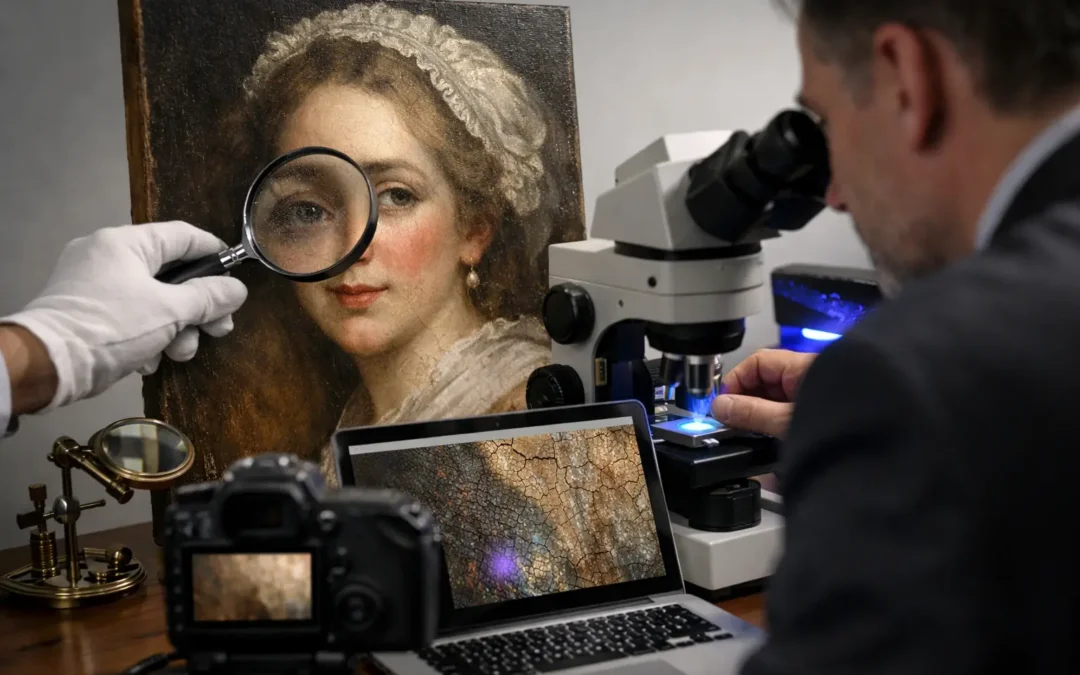
A convincing signature can be one of the least reliable features of a painting. Signatures are added, altered and copied; labels are moved between frames; family stories can become more certain with each retelling. Effective painting authentication methods therefore begin not with one attractive detail, but with a disciplined assessment of the whole object – its history, materials, condition, style and place within an artist’s known body of work.
For an owner preparing to sell, the distinction matters commercially. A work that is correctly attributed, properly catalogued and supported by evidence can attract informed competition. Conversely, an uncertain attribution must be described with care. At auction, confidence is valuable, but unsupported certainty is not.
Why attribution is rarely a single test
Authentication is often described as though a laboratory test can provide a simple yes or no answer. In practice, only a small number of questions can be settled so directly. A pigment analysis may show that a particular blue was unavailable during an artist’s lifetime, for example, but it cannot by itself prove who painted the picture.
The strongest opinions are built from converging evidence. An auction specialist may consider how the paint has been handled, whether the canvas or panel is appropriate, where the painting has been, whether comparable works are known, and whether the condition tells a coherent story. Each strand has a different weight depending on the artist, period and type of work.
This is also why the phrase ‘attributed to’ has a specific purpose in a catalogue. It signals a reasoned opinion, but not the same degree of certainty as a work catalogued unequivocally under an artist’s name. Terms such as ‘studio of’, ‘circle of’, ‘follower of’ and ‘after’ are not evasions. They are useful market descriptions which set out the relationship between a work and a named artist as accurately as current knowledge allows.
Painting authentication methods used in auction practice
Connoisseurship: the trained eye and comparative knowledge
Visual examination remains central. Specialists look at composition, draughtsmanship, brushwork, colour, light, surface texture and the way a subject has been constructed. An artist’s habits can be remarkably persistent: the treatment of hands, foliage, skies, highlights or folds of fabric may be more revealing than a signature.
This assessment depends on close comparison with accepted examples. A specialist will consider whether the painting sits convincingly beside known works from the proposed date, not simply whether it resembles the artist at a glance. Some artists employed assistants, worked in studios or produced variations of successful compositions, so similarity alone is not enough.
Connoisseurship has limits. It is necessarily informed judgement, and opinions can change when new archival material, technical analysis or catalogue raisonné research emerges. Its value lies in the quality of the comparison and the experience behind it, rather than an assertion based on instinct alone.
Provenance: establishing the chain of ownership
Provenance is the documented history of a painting’s ownership, exhibition and publication. A continuous, credible history can materially strengthen an attribution and may also affect desirability. Letters, invoices, old auction catalogues, exhibition labels, insurance schedules, collection inventories and photographs of a painting in situ may all be relevant.
Not every old label is proof. A dealer’s label may identify a retailer rather than the artist, and an inscription on the reverse may have been written many years later. Nevertheless, such evidence can provide valuable leads when read alongside the physical examination of the work.
For executors and families dealing with inherited pictures, this is a useful practical point. Before arranging a valuation, gather paperwork from drawers, files and the back of the frame. A faded catalogue entry or receipt that appears unremarkable may supply a date, a previous owner or a title that enables further research.
Examining the support, ground and paint surface
The physical construction of a painting often reveals more than the image on its face. Canvas weave, stretcher type, panel timber, priming layers, tacks, lining and frame construction can assist in placing a work within a period and region.
A nineteenth-century canvas on a modern machine-made stretcher is not necessarily deceptive – works are frequently relined or reframed during conservation – but the alteration must be understood. Condition reports are therefore closely connected to authentication. Areas of overpainting, abrasion, cleaning, later varnish and repaired tears may conceal or complicate original evidence.
Ultraviolet light is commonly used to identify later retouching and uneven varnish. It does not reveal every intervention, and interpretation requires experience, but it can show where further investigation is warranted. Raking light may expose impasto, cracks, distortions and changes to the surface that are not evident under ordinary lighting.
Scientific analysis: useful answers to focused questions
Technical analysis is most effective when it addresses a clear question. Infrared reflectography can sometimes reveal underdrawing or alterations beneath the paint surface. X-radiography may show earlier compositions, structural repairs or changes made by the artist. These findings can support an attribution where they correspond with known working methods.
Pigment and binding-medium analysis can identify materials used in the painting. If a pigment was introduced after the claimed date, that may be strong negative evidence. Equally, period-appropriate materials do not prove authorship, as many painters had access to the same supplies.
Dendrochronology, the dating of timber through tree-ring patterns, can be particularly helpful for paintings on oak panel. It may establish the earliest possible date at which a panel could have been used. The result is a terminus after which the picture was made, not an exact date of execution.
Such investigations can be costly and, in some cases, require microscopic samples. They should be commissioned proportionately. A modest decorative picture does not usually warrant an extensive scientific programme, while a work with a potentially significant attribution and market value may justify specialist reports.
Archives, catalogues raisonnés and recognised authorities
For many established artists, the catalogue raisonné is a key reference. It aims to record accepted works, sometimes with provenances, exhibition histories and literature. Inclusion can be influential, although the scope and reliability of catalogues vary greatly. Some are actively maintained; others are historic publications that require cautious use.
Artist foundations, estates, scholars and specialist committees may also provide opinions or issue certificates. Their authority depends on the artist and the organisation involved. Before relying on any certificate, consider who issued it, when it was issued, what evidence they reviewed and whether their opinion remains recognised in the market.
Archives can be equally revealing. A sitter, location, commission or exhibition number may connect an apparently anonymous work to documentary evidence. This research can take time, particularly where titles have changed or names have been recorded inconsistently.
What a seller should provide for a meaningful assessment
A good initial appraisal benefits from clear images of the front, back, signature, labels and any damage or restoration. Measurements should be taken accurately, and it is helpful to state whether they include the frame. Owners should also provide all available paperwork, however incomplete it may seem.
Do not clean a painting, remove a frame or attempt to improve a signature before seeking advice. A well-meaning intervention can remove evidence, affect value or make future examination harder. Equally, a family attribution should be presented as useful background rather than treated as proof. The most productive instruction is an open one: establish what the painting is, what can be supported, and the appropriate route to market.
At John Nicholson’s, preliminary valuation work is approached in that order. The aim is to identify the level of research a painting merits, describe it responsibly and place it in a sale where the right buyers can assess the evidence for themselves.
Certainty, value and the catalogue description
Authentication is not always resolved before a sale. There are circumstances in which a painting is properly offered as ‘attributed to’ or ‘circle of’, especially where the visual evidence is persuasive but documentary confirmation is absent. That does not make it a lesser exercise in scholarship; it makes it an honest description of the available evidence.
Buyers should read catalogue terminology, condition reports and provenance notes carefully, then inspect in person where possible. Sellers should understand that a conservative attribution can protect credibility and still generate strong interest when the quality of the picture is evident.
The best outcome is not simply a desirable name on a label. It is a painting whose attribution can withstand informed questions, whose condition is clearly represented, and whose history has been preserved for the next custodian.