
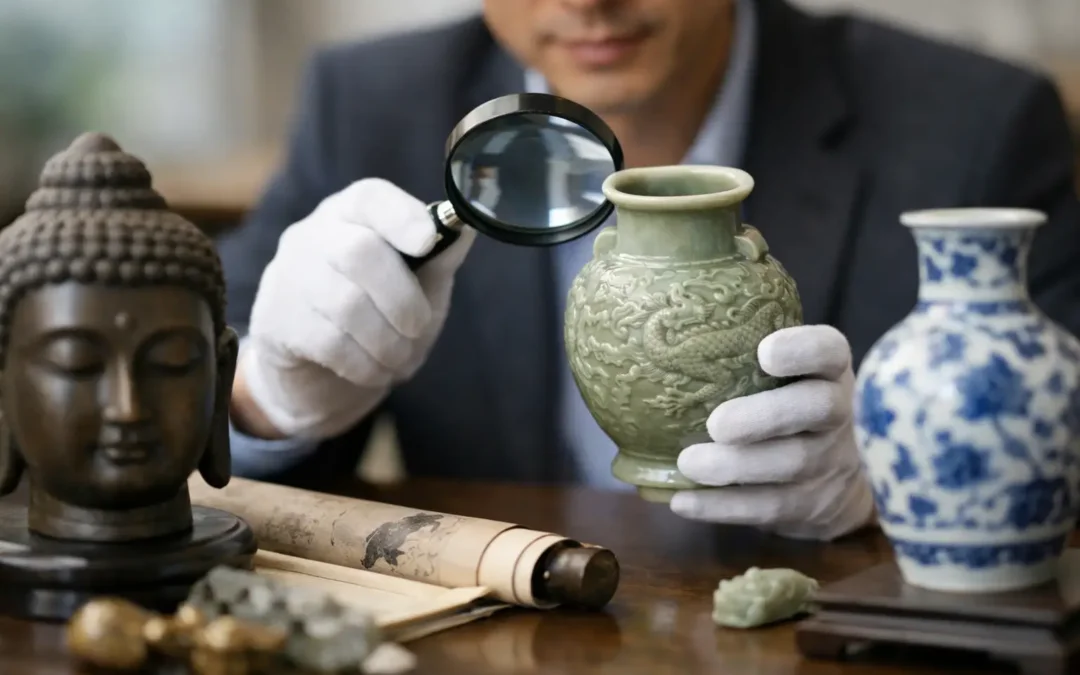
A porcelain bowl with a six-character mark, a Japanese woodblock print in a family album, or a carved jade pendant kept in a drawer may each require very different treatment at auction. Asian art auction specialists are engaged not simply to identify an object, but to establish what it is, how it was made, whether its history supports the attribution and where current market demand is likely to sit.
For sellers, this distinction matters. Objects described too broadly can be overlooked; objects described too confidently can attract scrutiny for the wrong reasons. For buyers, careful cataloguing provides a sounder basis on which to judge quality, condition, rarity and value. The work of a specialist is therefore part connoisseurship, part research and part market judgement.
Why specialist knowledge matters in Asian art auctions
The term Asian art covers an exceptionally broad field. It may include Chinese ceramics, bronzes, jade, works of art, paintings and textiles; Japanese prints, lacquer, swords, ceramics and metalwork; Indian and Himalayan sculpture; South East Asian works; and Islamic art from a wide range of cultures and periods. Materials, decorative languages, marks, workshop practices and collecting traditions vary considerably.
A small difference can alter an object’s position in the market. On Chinese porcelain, the shape of a footrim, the tone of a glaze, the quality of enamelling or the form of a reign mark may help distinguish an earlier example from a later copy or decorative revival piece. In Japanese prints, the impression, state, publisher, margins and degree of fading can be as significant as the design itself. A bronze may require close consideration of casting, patination, wear and whether a fitted base belongs to the piece.
This is why a general description such as “old Chinese vase” is rarely enough. It gives neither the seller nor the buyer a reliable account of the lot. A well-prepared catalogue entry should state what can be supported by examination, while making clear where an attribution is qualified.
What Asian art auction specialists examine
The first task is usually direct inspection. Photographs are useful for an initial conversation, but they cannot always show repairs, texture, weight, construction or the subtleties of a surface. Where a piece merits further consideration, the specialist will assess a combination of physical evidence, documentary evidence and comparable market results.
Age, origin and attribution
Age is not established by appearance alone. A convincing-looking object may be a later reproduction, while an unassuming piece may prove to be early and significant. Specialists consider the material, manufacture, decoration, wear patterns and any marks or inscriptions. They also compare the object with known examples, auction records and reference material.
Attribution is often a matter of degree rather than certainty. Catalogue language has a practical purpose: “Qianlong period”, “late Qing dynasty”, “in the style of”, “attributed to” and “after” do not mean the same thing. Each phrase signals a different level of confidence and should be used carefully. Sensible qualification protects the integrity of the sale and allows bidders to make properly informed decisions.
Condition and restoration
Condition is central to value, particularly in ceramics, paintings, lacquer and works on paper. A hairline crack, rim chip, overpainted area, replacement handle or polished section may have a marked effect on value, even where an object remains visually attractive. Conversely, honest wear can be expected in an early object and may be less concerning than poorly executed restoration.
Condition should be assessed in relation to the category and the object’s rarity. A common decorative vase with extensive repair may struggle to attract interest. A rare early bowl with a small, stable flaw may still be highly sought after. There is no universal rule that restoration makes an item unsaleable, but it must be identified where possible and reflected in the estimate.
Provenance and collection history
Provenance can strengthen confidence, particularly for works with a long family history, old collection labels, exhibition references, invoices or earlier auction catalogues. It can also help establish when an object was acquired and whether its ownership history is consistent with the period claimed.
Not every valuable object will have a complete documentary trail. Many inherited pieces arrive with only family recollections, and that does not automatically diminish their interest. However, sellers should provide all available information, including old receipts, correspondence, labels, photographs of objects in situ and details of inheritance. A seemingly minor paper label may be useful evidence.
Provenance also requires careful handling. An auction house must consider whether there are concerns around ownership, cultural property or export restrictions. These questions are not an inconvenience to be bypassed; they are part of responsible auction practice and can affect whether, where and how a lot may be offered.
Rarity, quality and current demand
Age alone does not create value. A later object of exceptional workmanship, fine condition and strong decorative appeal can perform very well, while an early but ordinary example may attract more limited bidding. The best estimates bring together rarity, quality, condition, provenance and the depth of the current buyer base.
Demand can also shift by category. Chinese ceramics and jade may appeal to international collectors, while a strong Japanese print can draw interest from both specialist buyers and those furnishing a particular interior. Some areas attract sustained competition; others are more selective and depend heavily on subject, artist, condition or the presence of a respected collection provenance.
The estimate should be a commercial judgement rather than an aspirational figure. Setting it too high can deter early bidding and leave a desirable lot exposed. Setting it unrealistically low may concern a seller, although a competitive estimate can encourage participation and allow the market to establish the result. The appropriate approach depends on the object, the sale format and the evidence available.
Preparing Asian art for valuation and sale
Sellers can make the valuation process more effective without attempting to clean, repair or improve an object themselves. Do not wash porcelain, polish bronze, remove old mounts or use household adhesives on damaged pieces. Such interventions can erase evidence, alter surfaces and reduce value.
Gather the supporting material instead. Record where and when the item was acquired, whether it formed part of a wider collection, and whether there are matching pieces, boxes, stands, certificates or receipts. Photograph marks, labels and inscriptions before moving the object. If a painting, scroll or screen has been stored away, keep it dry and protected from direct sunlight until it can be inspected.
It is also useful to be realistic about what a valuation can establish from photographs alone. Clear images of the front, back, base, marks, details and any damage are helpful, but a specialist may need to inspect the item in person before recommending an estimate or sale strategy. This is particularly true for higher-value ceramics, jades, bronzes and paintings.
Selecting the right sale and reaching buyers
A specialist auction is not merely a date in the diary. It is a carefully assembled group of lots presented to buyers who follow that field. The right sale context can improve visibility: a Chinese famille rose bowl is more likely to be considered properly when offered alongside related ceramics and works of art than when buried in a broad household clearance sale.
Presentation matters as well. Accurate measurements, strong photography, a precise condition report and a disciplined catalogue description allow distant bidders to participate with greater confidence. This is especially important where online and telephone bidding extends the audience beyond the saleroom.
At John Nicholson’s, specialist cataloguing and established auction channels are used to place suitable Asian art before collectors, dealers and international bidders. Yet the object itself remains the deciding factor. A modest but honest lot should be described honestly; a significant work should be researched and presented with the attention its market position warrants.
Questions buyers should ask before bidding
Buyers should read the catalogue description closely and request a condition report where one is available. Ask about restoration, cracks, chips, fading, relining, backing boards, mounts and any visible alterations. For works carrying a mark, clarify whether the mark is presented as contemporaneous with the object or simply as a later decorative feature.
Examine provenance statements with the same care. A collection label may be useful, but it is not always proof of age or authorship. Equally, the absence of provenance does not mean that a lot lacks merit. The question is whether the description, condition and estimate collectively offer a basis on which you are comfortable bidding.
Allow for the buyer’s premium, applicable taxes, packing and transport before setting a limit. In a competitive auction, a clear budget is often more valuable than a last-minute reaction to another bidder.
The strongest results in Asian art come from clear evidence, measured cataloguing and a sale strategy matched to the object. If you are considering a valuation, keep the piece untouched, retain every scrap of accompanying history and seek a specialist view before deciding its next step.