
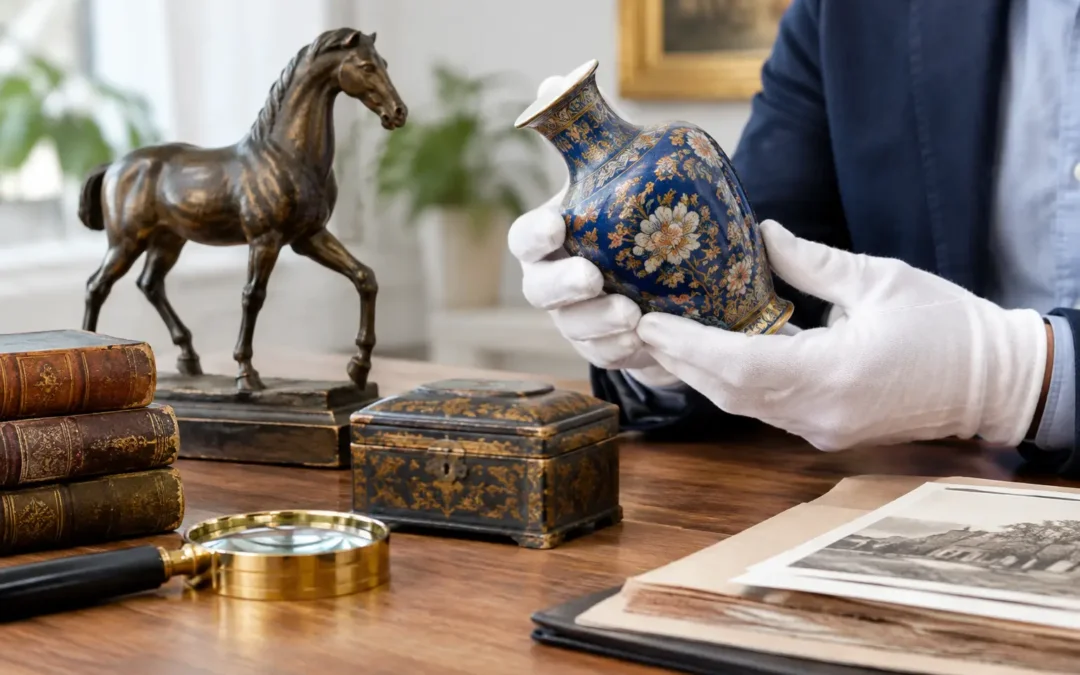
A handwritten label beneath a cabinet, an old invoice tucked into a picture frame, or a photograph showing a vase in a family home can alter the saleability of an object materially. The question of which antiques need provenance is therefore not reserved for museum-quality pieces. It arises whenever an item’s ownership history affects its legality, attribution, cultural status or the confidence with which a buyer will bid.
Provenance is the documented history of an object’s ownership, location and movement. In auction practice, it is not simply a pleasing story. A clear chain of ownership can support an attribution, distinguish an original from a later copy, reduce legal and ethical concerns, and widen the field of serious buyers. Equally, gaps in the record do not automatically make an antique unsaleable. The significance depends on the category, date, country of origin and value.
Which antiques need provenance most urgently?
The need is strongest where an object may have been subject to export controls, wartime displacement, archaeological protection or restrictions on trade in protected materials. These categories require careful handling before a catalogue description, estimate or sale strategy can be settled.
Archaeological objects and antiquities
Ancient coins, Roman bronzes, Egyptian figures, pottery fragments, Near Eastern seals and similar objects need particularly careful provenance. Their country of origin can be difficult to establish visually, while excavation, export and ownership may be governed by laws that differ substantially between jurisdictions.
For material found in the United Kingdom, find records, landowner permissions and any relevant reporting documentation may be highly significant. For objects acquired abroad, old collection labels, invoices, auction catalogues, export licences and records showing when the object entered the United Kingdom can all help establish a legitimate collecting history.
An object described merely as being from an “old family collection” may still be saleable in some circumstances, but it is less satisfactory than a documented history. Buyers of antiquities are increasingly alert to collecting dates and will often expect evidence that an item was outside its likely country of origin before modern restrictions or periods of heightened risk.
Works of art with wartime European history
Paintings, drawings, sculpture, Judaica, furniture and decorative arts with a continental European history between 1933 and 1945 demand close attention. During this period, many objects were confiscated, forcibly sold or displaced. A work that passed through Germany, Austria, France, the Netherlands or occupied territories may require research even where the current owner acquired it innocently many decades later.
Here, provenance is not a decorative addition to a catalogue entry. It is central to responsible due diligence. Old dealer labels, exhibition catalogues, collection stamps, photographs of interiors, insurance schedules and correspondence can be useful. So can a continuous ownership history reaching back before the period in question.
A gap does not prove a problem, but unexplained gaps should not be ignored. A cautious auctioneer may need to qualify the catalogue entry, conduct further checks or decide that the work is unsuitable for sale until satisfactory evidence is available.
Asian art, Islamic art and objects with export sensitivity
Chinese ceramics, jade, bronzes, Indian sculpture, Tibetan religious objects, Islamic manuscripts and metalwork can carry significant provenance requirements. These are internationally traded fields, often involving objects that have changed countries several times over long periods. They also attract informed buyers who understand the distinction between an object with a traceable pre-war collection history and one with no recorded ownership before the recent market.
For high-value Asian art, an old auction catalogue, collector’s inventory, dealer invoice or label from a recognised exhibition can add commercial force as well as reassurance. A documented history may support the date, authenticity and condition of an object, particularly where comparable pieces have been widely copied or restored.
The same principle applies to Islamic art. A manuscript, tile panel or metalwork object with a named private collection or published exhibition history is generally easier to catalogue and market than an apparently similar item without supporting records.
Ivory, tortoiseshell and protected natural materials
Items containing ivory, whether in miniature portraits, piano keys, carving, inlay, handles or decorative mounts, need specialist attention. Restrictions on dealing in ivory are stringent and depend on the nature, date and composition of the item, as well as any applicable exemption or registration requirement.
Tortoiseshell, rhinoceros horn, coral, certain shells, feathers and other protected materials can raise comparable issues. The fact that an object is antique does not automatically mean it can be sold freely. Good provenance may help establish age and lawful acquisition, but documentation alone is not a substitute for considering the relevant regulations.
Sellers should avoid removing materials, polishing surfaces aggressively or altering an object before it has been assessed. Such actions can damage both evidential value and market value.
Provenance that adds value, even when it is not compulsory
Not every antique requires a long documentary trail to be offered at auction. Georgian furniture, British ceramics, silver, clocks, glass and ordinary decorative objects are often sold on their visible merits, condition, maker’s marks and market comparables. Yet ownership history can still make a difference.
A Regency table supplied to a named country house, a clock retained by one family since the nineteenth century, or a service of porcelain recorded in an estate inventory has a stronger commercial narrative than an unrecorded equivalent. If that history can be verified, it may influence buyer interest and, in the right market, the estimate.
For fine paintings, provenance can be especially valuable where it supports authorship. A work accompanied by a label from a respected dealer, a past auction catalogue entry, exhibition history or a mention in a catalogue raisonné gives buyers more to assess than style alone. That does not guarantee attribution, but it can materially improve the basis on which specialists form an opinion.
Jewellery also benefits from its history. Original purchase receipts, maker’s cases, laboratory reports, old valuations and family photographs can support the identity and date of a piece. For signed jewellery, these details may strengthen confidence, although condition, alterations and the presence of original components remain equally relevant.
What counts as useful provenance?
The best provenance is contemporaneous, specific and capable of being checked. A sequence of invoices, old sale catalogues, insurance valuations, correspondence and photographs is usually more persuasive than a single modern letter repeating family tradition. Original documents are preferable, though good-quality copies may still be useful where originals are retained for estate records.
Useful evidence can include:
- purchase invoices and receipts;
- past auction catalogues, lot numbers and condition reports;
- collection inventories, wills and probate papers;
- dealer labels, exhibition labels and transport marks;
- photographs showing the object in a recognisable setting;
- export licences, import records and specialist certificates.
A collector’s handwritten note should be retained, but treated with appropriate caution. It may provide an excellent lead for research without, on its own, proving every claim it makes. The same applies to oral family history. Record names, dates and recollections while they are available, then support them where possible with papers or public records.
Gaps, inherited objects and sensible next steps
Many consignors encounter provenance questions after an inheritance. It is common to have a house full of objects but only fragments of paperwork. There is no advantage in reconstructing a history from guesswork, and sellers should be direct about what is known, what is believed and what cannot be confirmed.
Begin by keeping associated documents together. Do not discard old frames, labels, cases, receipts or correspondence simply because they appear untidy or irrelevant. Photograph objects before cleaning or moving them, particularly if they bear seals, inscriptions, collection numbers or customs marks. If several objects came from the same home or collection, preserve that connection: the grouping itself may be useful evidence.
An auction valuation can then identify which items warrant deeper research. This is a proportionate exercise. Spending weeks tracing the ownership of a modest decorative lot may not be commercially sensible, whereas the same effort for a significant bronze, painting or rare manuscript can protect value and prevent a sale from being delayed.
At John Nicholson’s, specialist assessment considers the object itself alongside its supporting history. A clear, candid file enables an auctioneer to advise on attribution, estimate, catalogue wording and whether further checks are required before the lot is offered.
The most useful approach is straightforward: preserve every piece of evidence, disclose uncertainty early, and seek advice before placing a potentially sensitive object on the market. A well-documented history does not merely satisfy due diligence; it gives the right buyers a sound reason to bid with confidence.
